
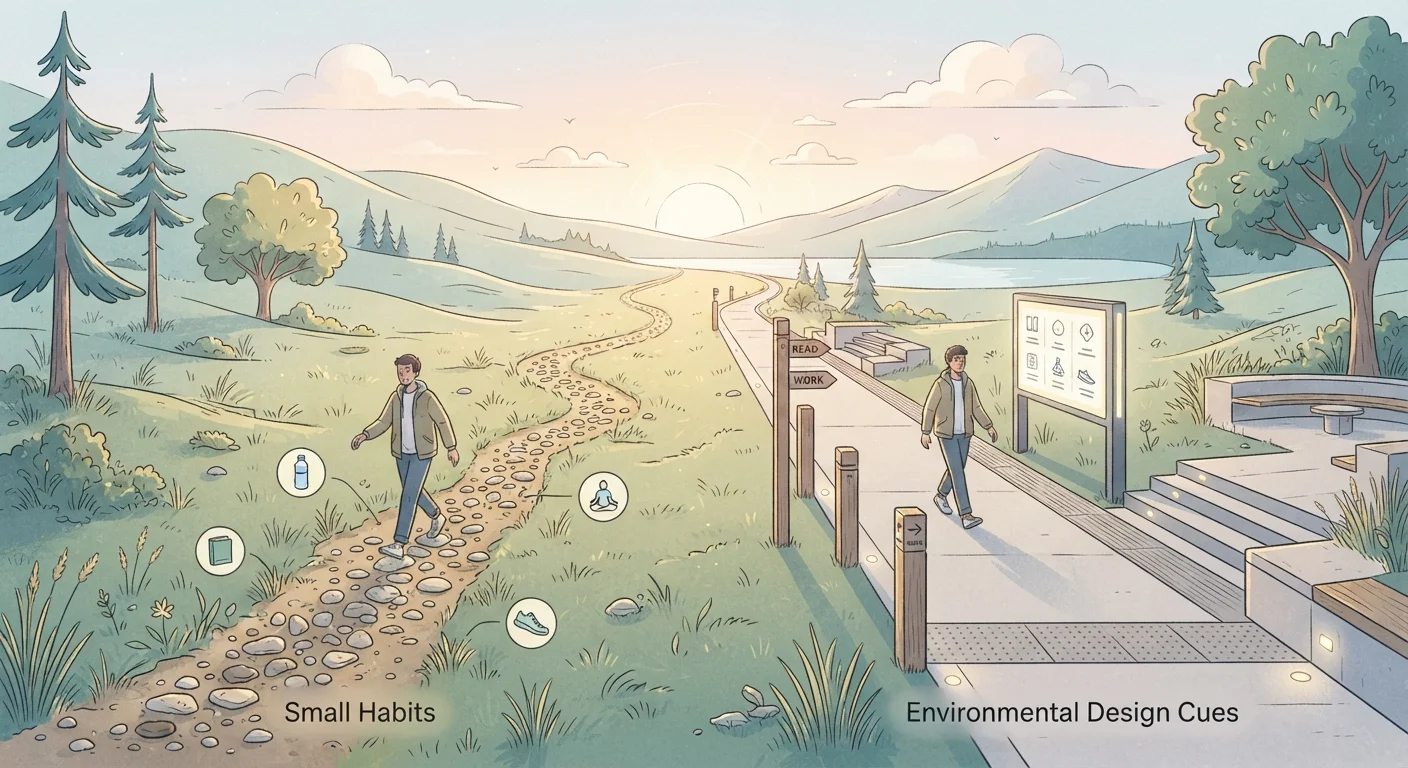
What Each Framework Actually Proposes
The term atomic habits comes from James Clear's widely read work on behavior change. Its core premise is that small, 1% improvements compound dramatically over time, and that lasting behavior change starts with reshaping your identity - deciding what kind of person you want to be, then casting votes for that identity through daily actions. The framework organizes habits around a four-stage loop: cue, craving, response, and reward. Interventions work by making desired behaviors obvious, attractive, easy, and satisfying.
Behavior design, developed by Stanford researcher BJ Fogg, takes a different starting point. Fogg argues that motivation is unreliable, and that the most powerful lever for change is shrinking a target behavior until it requires almost no effort - what he calls a "tiny habit." Equally important is anchoring that behavior to an existing routine (an "anchor moment") and redesigning the physical or digital environment so that good behaviors become the default. Emotion, particularly celebration after a small win, is positioned as the primary driver of habit formation rather than repetition alone.
Both frameworks draw on behavioral science and have been widely applied in clinical, educational, and corporate settings, though neither should be treated as a guaranteed solution - individual results vary considerably.
Where They Agree - and Where They Diverge
The two approaches share meaningful common ground. Both reject the idea that willpower or motivation is sufficient for lasting change. Both emphasize environmental design: Clear's concept of "reducing friction" and Fogg's idea of "redesigning the environment" are functionally similar. Both also recognize that habits must be rewarding in the short term to survive long enough to become automatic.
The divergence is more philosophical than tactical. Atomic habits places identity at the center - the goal is to become a certain type of person, and habits are evidence of that identity. Behavior design is largely agnostic about identity; it focuses instead on the situational architecture that makes a behavior easy to perform right now. This distinction matters in practice: the atomic habits approach encourages a longer-term mindset shift, while behavior design can generate quick wins that build confidence and momentum from day one.
| Atomic Habits | Behavior Design (Fogg) | |
|---|---|---|
| Core philosophy | Identity-based change through small improvements | Shrink behavior; design environment for ease |
| Primary lever | Cue-craving-response-reward loop | Anchor moment + tiny behavior + celebration |
| Role of motivation | Motivation supported by identity alignment | Motivation treated as unreliable; minimize reliance |
| Environmental design | Reduce friction; make cues visible | Central strategy; redesign defaults first |
| Time horizon | Long-term compounding mindset | Immediate wins that build momentum |
| Best starting point | Clear goal, needs systematic structure | Low motivation, needs low-friction entry |
For a closer look at one tactic that appears in both frameworks - anchoring new behaviors to existing ones - see our analysis of the trade-offs of habit stacking.
Applying Each Framework to Real-Life Goals
Consider someone trying to build a consistent exercise routine. Using the atomic habits framework, they might start by reframing their identity: "I am someone who moves my body daily." They would then redesign cues (laying out workout clothes the night before), reduce friction (choosing a gym near their commute), and track their streak to make progress visible and satisfying. For further reading on why exercise routines break down and how to counter that, see why fitness habits collapse after a few weeks.
Using behavior design, the same person would shrink the behavior radically - perhaps to just putting on athletic shoes after brushing teeth each morning. The anchor (tooth brushing) triggers the tiny habit (shoes on), and immediate celebration - even a brief internal acknowledgment - wires in positive emotion. The goal is not to force a workout but to let motivation grow naturally from repeated small successes.
Try Combining Both Approaches
Start with behavior design's shrink-it-down principle to get a new behavior into your routine without relying on motivation. Once the action is consistent, layer in the atomic habits identity framing - 'I am someone who does X' - to give the behavior staying power. This sequencing addresses both the initiation problem and the long-term maintenance problem.
Both frameworks can also apply beyond fitness. Budgeting routines, reading habits, and professional skill-building all respond to the same underlying principles. The concept of keystone habits offers a useful complement here - identifying one foundational behavior that triggers positive ripple effects across multiple areas of your life.
Choosing the Right Starting Point for You
If you find that you already have a clear vision of who you want to become but struggle to make your routines stick, the atomic habits framework's identity-based structure may give you the scaffolding you need. It works particularly well for people who are motivated by progress tracking and incremental mastery.
If motivation itself feels like the barrier - if starting feels overwhelming or you've experienced repeated false starts - behavior design's emphasis on shrinking behaviors and removing friction may be more accessible. It's especially effective for people who benefit from celebrating small wins early rather than waiting for long-term results to materialize.
Many practitioners borrow deliberately from both: using behavior design to establish a foothold (tiny, low-friction actions) and atomic habits to sustain and expand those actions over time through identity reinforcement and systematic cue design. Neither framework is a rigid program; both are meant to be adapted. What matters most is honest self-assessment about where your current barriers actually lie - in motivation, environment, or mindset.
This article is for general informational and educational purposes only. It does not constitute professional psychological, medical, or personalized behavioral coaching advice. Readers with specific concerns about mental health or behavior change should consult a qualified professional.