
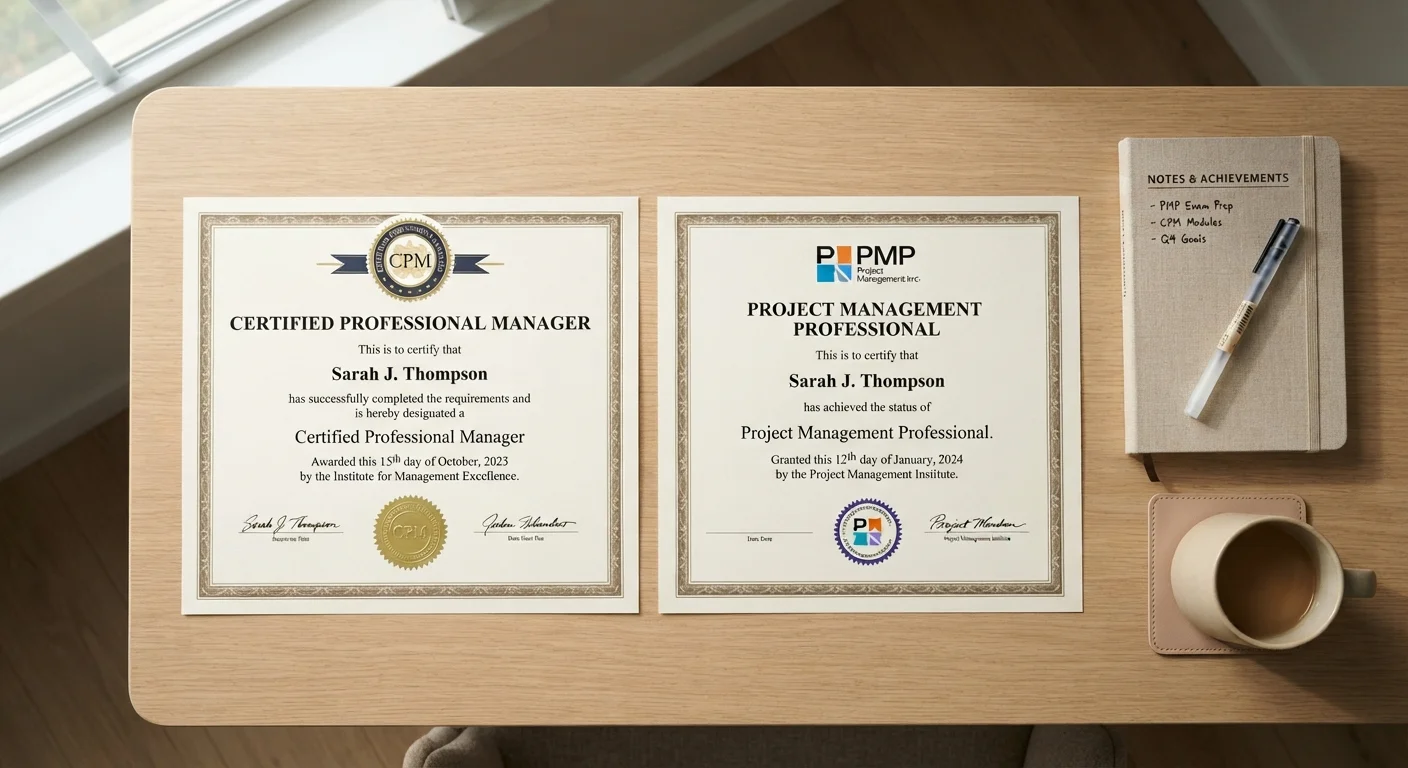
Why Two Credentials in the Same Field Can Look Identical - But Aren't
It's common to encounter two certifications that appear to certify the same competency. Both might sit within project management, cybersecurity, financial planning, or another field you're targeting. Both might show up in job postings. Yet the people who hold each credential, the organizations that grant them, and the signals they send to employers can differ considerably.
Before assuming either choice is arbitrary, it helps to understand what professional certifications actually represent. As explained in our overview of industry certifications, these credentials signal demonstrated competency validated by an independent body - and the weight they carry is largely determined by the body behind them and the community that recognizes them.
Two credentials may overlap in subject matter while diverging on rigor, cost, recognition, and the career stage they're designed for. Treating them as interchangeable is a common and costly mistake.
A Framework for Comparing Any Two Credentials
Rather than relying on informal reputation, evaluate credentials across five consistent dimensions.
| Dimension | Credential A (General) | Credential B (General) | |
|---|---|---|---|
| Employer recognition | Frequency in job postings | Frequency in job postings | Frequency in job postings |
| Issuing body credibility | Criteria | Accredited / industry-backed? | Accredited / industry-backed? |
| Eligibility requirements | Criteria | Experience hours required | Experience hours required |
| Total cost (exam + prep) | Criteria | Exam fee + materials | Exam fee + materials |
| Renewal cycle | Criteria | Years + CEU requirements | Years + CEU requirements |
| Exam format | Criteria | Scenario-based / recall | Scenario-based / recall |
| Career stage fit | Criteria | Entry / mid / senior | Entry / mid / senior |
Employer recognition is often the deciding factor. Search active job postings in your target role and region, then count how often each credential appears in requirements or preferred qualifications. That frequency is a more reliable signal than any ranking list.
Eligibility fit matters next. Some certifications require years of documented experience before you can even sit for the exam. If you don't meet the prerequisites, the question resolves itself - at least for now.
Cost and renewal burden affect long-term value. Exam fees, study materials, and continuing education requirements all factor into the real investment. For guidance on what renewal actually entails, see our article on keeping credentials current.
Use Job Postings as a Scorecard
Pull 20-30 active job listings for your target role from two or three major job boards. Tally how often each credential appears - in required vs. preferred sections separately. This simple count gives you data-driven clarity that generic reputation comparisons often can't provide. Update your search periodically, as hiring patterns can shift as industries evolve.
How to Read Job Market Signals Accurately
Job postings are your most reliable external data source. When researching, look beyond whether a credential is mentioned - look at how it's mentioned. A credential listed as "required" carries more weight than one listed as "a plus." Also note the size and type of employers citing each one: a credential dominant at large enterprises may be less visible in startups or specialized consultancies, and vice versa.
Geography adds another layer. Some credentials enjoy stronger regional adoption due to licensing norms, industry concentrations, or professional associations with local chapters. A credential widely recognized on the East Coast may appear less often in postings centered in the Southwest or Pacific Northwest.
If you're still building a sense of what the credential landscape looks like in your field, our look at high-value certifications across six career fields offers useful context for how recognized credentials tend to cluster by industry.
When You Genuinely Can't Decide - and What to Do
If both credentials clear your employer-recognition and eligibility tests, shift your analysis inward. Which exam format and preparation style suits how you learn? Some certifications are heavily scenario-based and reward applied experience; others are more knowledge-recall oriented. Your approach to exam prep can be just as important as the credential itself - common preparation pitfalls are covered in detail in our guide on why certification prep often fails.
Also consider whether holding one credential opens a faster path to the second. Many professional bodies allow credential-holders to waive certain prerequisites or receive exam credit. In that case, sequencing your pursuit thoughtfully - rather than treating it as a permanent either/or - gives you a clear action plan without foreclosing future options.
If you're newer to the certification process overall, the beginner's guide to professional certifications can help you contextualize these trade-offs before committing to either path.
This article is for general informational and educational purposes only and does not constitute professional career, financial, or legal advice. Readers should verify credential requirements directly with the issuing organizations before making decisions.