Why Timelines Matter More Than Motivation
Online learning platforms have done a remarkable job making education accessible - but their marketing often overpromises. Phrases like "learn Python in a weekend" or "fluent in 30 days" set expectations that most learners can't meet, and when reality falls short, people often blame themselves rather than the misleading timeline.
Learning science offers a more honest picture. Skill development isn't linear, and how long it takes depends on three intersecting factors: the complexity of the skill itself, the quality and structure of your practice, and how many hours per week you can realistically commit. Understanding these variables upfront helps you set goals you can actually reach - and stay motivated when progress feels slower than advertised.
For context, researchers studying skill acquisition have found that reaching basic functional competence in a new area typically requires somewhere between 20 and 100 hours of deliberate, focused practice - depending heavily on the domain. Professional-level proficiency in complex skills can extend into the hundreds of hours or more. Neither figure is a ceiling or a guarantee; they're rough anchors for calibrating expectations.
What Learning Research Actually Shows
The most durable insights from cognitive science point to a few evidence-backed principles that consistently outperform passive consumption habits.
20-50 hrs
Hours to reach basic competence in a new skill
Researcher Josh Kaufman has argued that deliberate focused practice of roughly 20 hours is often sufficient to move from knowing nothing to basic functional ability in many domains.
~50%
Improvement in retention from retrieval practice
Multiple studies in cognitive psychology, including work reviewed by Roediger and Butler, suggest active retrieval practice can improve long-term retention by roughly 50% compared to passive re-study.
Spaced > Massed
Spacing practice sessions outperforms cramming
The spacing effect - one of the most replicated findings in learning research - shows that distributing practice over time consistently produces stronger long-term retention than equivalent massed practice.
Spaced repetition - reviewing material at gradually increasing intervals rather than cramming - has been shown across decades of research to significantly improve long-term retention. Active retrieval practice (quizzing yourself, solving problems from memory, or explaining concepts aloud) produces stronger learning than re-reading or re-watching the same material. Both techniques are practical in online learning contexts and require no special tools beyond discipline.
Another important distinction: time on task is not the same as productive learning time. Passively watching a 40-hour course may feel like progress, but if you're not actively engaging, testing yourself, and applying what you learn, a substantial portion of that time may not convert into retained skill. This is sometimes described in research as the "illusion of knowing" - where familiarity with material is mistaken for actual competence.
“The most important thing about deliberate practice is that it is not mindless repetition. It requires full attention and is conducted with the specific goal of improving performance.”
— Anders Ericsson, Cognitive psychologist and researcher on expert performance, Florida State University
For readers juggling work, family, and other obligations, these principles also carry practical implications. Shorter, more frequent study sessions (say, 30 minutes four times a week) often outperform long infrequent blocks. Our article on skill-building on a tight schedule explores how to structure practice around real-life constraints.
The '10,000 Hours' Myth - and What It Actually Meant
Few ideas about skill-building have spread as widely - or been as misapplied - as the 10,000-hour rule. The figure entered popular culture through Malcolm Gladwell's book Outliers, which drew on research by psychologist Anders Ericsson studying elite performers in fields like music and chess.
What's often missed: Ericsson's original research emphasized deliberate practice - highly structured, goal-oriented effort with expert feedback - not simply spending time doing something. Ericsson himself later noted that the 10,000-hour framing was oversimplified and that the number varied substantially across domains and individuals.
For most practical, career-oriented skills - data analysis, graphic design, copywriting, a new coding language - reaching a genuinely useful, employable level of competence is typically achievable in far fewer hours through well-structured deliberate practice. This is good news for online learners, provided they focus on quality of practice rather than time logged.
It's also worth noting that "competent enough to use the skill professionally" and "world-class expert" are very different targets. Most online learners are aiming for the former, which is a realistic and meaningful goal. For perspective on how employers evaluate skill level regardless of how it was acquired, see our piece on what hiring managers actually see.
Building a Realistic Personal Timeline
Rather than accepting a platform's promised timeframe at face value, it's more useful to build your own estimate from the ground up. Start by identifying the specific outcome you want - not "learn data science" but "be able to clean a dataset and build a basic visualization in Python." Concrete targets are easier to plan for and easier to measure.
Next, be honest about your weekly availability. Five hours per week versus fifteen hours per week will produce dramatically different calendar timelines for the same skill goal - even if the total hours of practice needed are identical. A learner with five hours weekly will need three times as many calendar weeks to accumulate the same practice as someone with fifteen.
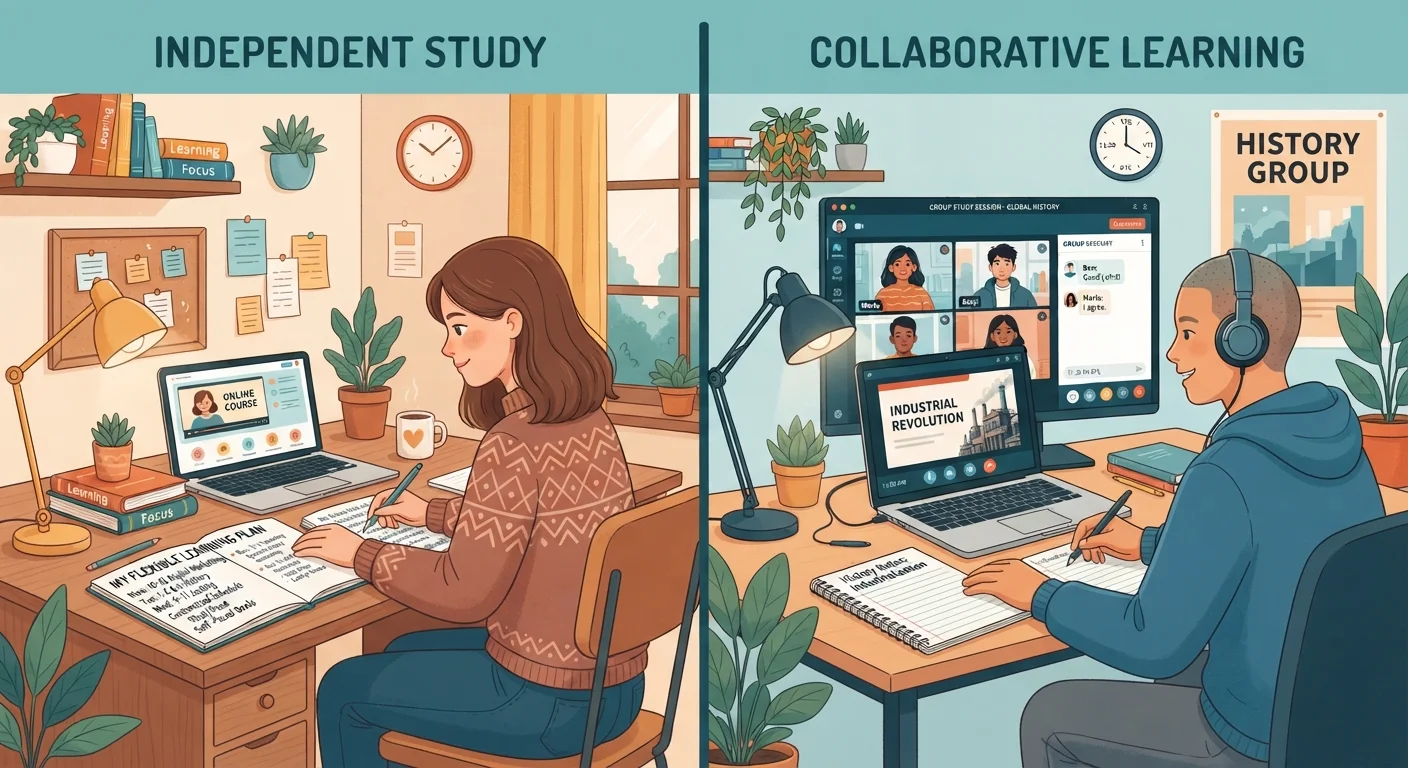
Finally, factor in the structure of your learning path. Course format affects more than convenience - cohort-based programs with deadlines and peer interaction tend to create accountability that supports consistent progress. If you're choosing self-paced, build in your own checkpoints and review mechanisms.
Once you're learning, track progress in terms of what you can do, not what you've watched. Our guide on measuring what you've actually learned offers practical frameworks for this. And when you're ready to choose a platform, our walkthrough on picking an online learning platform can help you evaluate options without the noise.