
Why Self-Improvement Myths Are So Sticky
Self-improvement advice spreads fast - especially when it comes packaged in a memorable number or a clean framework. The problem is that many widely repeated ideas are either oversimplified or directly contradicted by behavioral research. For ambitious young adults trying to build better routines, acting on faulty premises can waste time and chip away at confidence when the promised results don't appear.
This article walks through five of the most common self-improvement myths, replaces each with what the evidence actually shows, and points toward more grounded approaches to personal growth. If you want to take stock of your current routines after reading, the Personal Growth Habit Audit checklist is a practical next step.
Myth
It takes exactly 21 days to form a new habit.
Fact
Research suggests habit formation varies widely, typically ranging from 18 to 254 days depending on the person and behavior.
The 21-day figure is often traced back to observations made by plastic surgeon Maxwell Maltz in the 1960s - not a controlled study. A more rigorous investigation published in the European Journal of Social Psychology by Phillippa Lally and colleagues found that participants took anywhere from 18 to 254 days before a behavior became automatic, with a median around 66 days. Expecting a habit to click in three weeks and then abandoning it when it hasn't can create a false sense of personal failure where none exists.
Myth
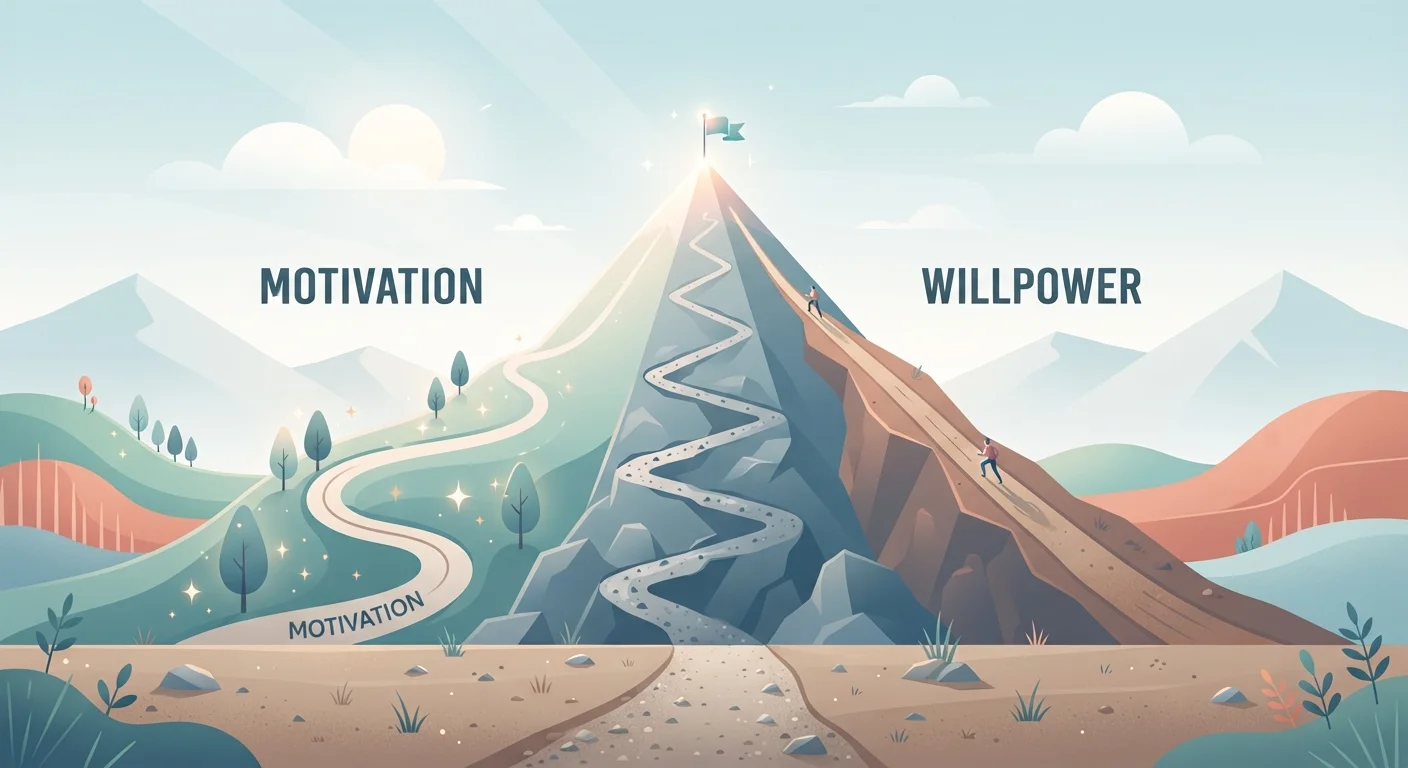
Willpower works like a fuel tank - once it's depleted, it's gone for the day.
Fact
The 'ego depletion' model has faced significant replication challenges, and willpower appears more context-dependent than the simple fuel metaphor implies.
The ego depletion hypothesis - popularized in the 1990s - suggested that self-control draws on a limited glucose-powered reserve that empties with use. However, large-scale replication efforts, including a multi-lab study published in Perspectives on Psychological Science, found weak or inconsistent support for the effect. More recent frameworks suggest that beliefs about willpower, motivation, and situational context play a larger role than a fixed biological resource. That said, fatigue, stress, and decision overload do affect self-regulation - the mechanism is just more nuanced than a single tank running dry.
Myth
Multitasking helps you get more done in less time.
Fact
The human brain does not truly multitask on complex cognitive work - it switches rapidly between tasks, and each switch carries a cost.
Research from cognitive psychology consistently shows that what we call multitasking is actually task-switching, and each switch incurs a measurable time and accuracy penalty. A study by David Meyer and colleagues estimated that switching between tasks can cost as much as 40% of productive time in complex work. For straightforward or highly automated tasks, simultaneous activity may be less disruptive - but for anything requiring sustained attention or learning, divided focus reliably reduces quality. If the risks of split attention in physical settings interest you, distracted driving research makes the same point forcefully: see Distracted Driving Myths That Still Put People at Risk.
Myth
You need to feel motivated before you can take meaningful action.
Fact
Motivation frequently follows action rather than preceding it - starting small is often what generates the feeling of readiness.
Waiting until motivation arrives is one of the most common ways ambitious people stall. Behavioral activation research - originally developed in clinical psychology - demonstrates that engaging in a behavior, even at reduced intensity, tends to generate the emotional state that supports further action. In practical terms, this means committing to five minutes of a task rather than waiting for the "right mood." The act of beginning rewires the internal state, rather than the internal state enabling the act.
Myth
Positive thinking is enough to drive real change.
Fact
Untempered positive visualization can actually reduce the likelihood of achieving goals by diminishing the sense of urgency needed to act.
Psychologist Gabriele Oettingen has spent decades studying the effects of positive fantasy on goal pursuit. Her research consistently finds that purely positive visualization - imagining the desired outcome without acknowledging obstacles - can lower energy and motivation by signaling to the brain that the goal is already achieved. The more effective approach she identified, called mental contrasting, pairs a positive vision of the goal with a realistic appraisal of what stands in the way, then links specific if-then plans to those obstacles. This combination, which she calls WOOP (Wish, Outcome, Obstacle, Plan), shows stronger results across goal domains ranging from academic performance to health behavior change.
What the Evidence Points Toward Instead
Replacing myths with accurate mental models isn't just about being right - it's about building a foundation that actually supports sustained change. A few practical reframes are worth keeping in mind.
Design your environment before relying on discipline. Since willpower is not an inexhaustible resource, reducing friction matters more than heroic self-control. Lay out workout clothes the night before. Remove distractions from your workspace. Make the default behavior the behavior you want.
Start before you feel motivated. Action tends to generate motivation, not the other way around. Beginning a small task - even a two-minute version of it - is often enough to shift your internal state. For a deeper look at how discipline, motivation, and willpower each operate differently, see Self-Discipline, Motivation, and Willpower: Understanding the Differences.
Pair realistic optimism with concrete plans. Gabriele Oettingen's research on mental contrasting suggests that imagining a goal and anticipating obstacles produces better outcomes than purely positive visualization. Think through what could go wrong and plan specifically for it.
For routines that have shown durability across different life stages, Self-Improvement Habits That Hold Up Across Life Stages offers a research-grounded overview. And if you're considering habit stacking as part of your system, it's worth reviewing the trade-offs of that approach before building your routine around it.
66 days
Median time to habit automaticity
According to a study by Lally et al. published in the European Journal of Social Psychology, habit formation took between 18 and 254 days across participants.
~40%
Productive time lost to task-switching
Research by cognitive psychologist David Meyer and colleagues estimated up to 40% productivity loss when people switch between complex cognitive tasks.