
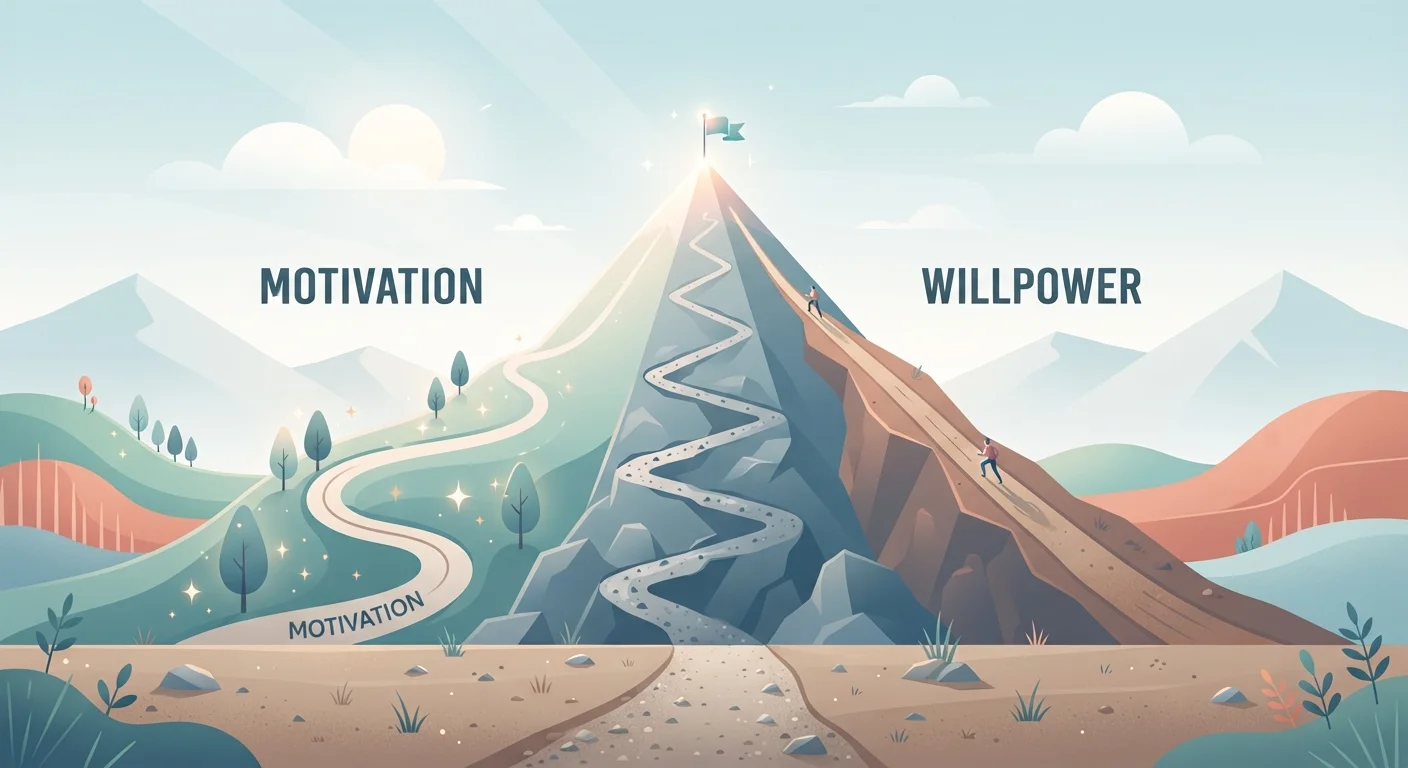
Why the Distinction Matters
Most people use motivation, self-discipline, and willpower as if they mean the same thing. They don't - and confusing them leads to a common trap: waiting to feel motivated before acting, burning out by forcing willpower, or mistaking a bad habit loop for a discipline problem.
Understanding how each concept works - and when to lean on which - is one of the more practical mindset shifts available to ambitious young adults. It also connects directly to the kind of self-awareness discussed in our article on fixed vs. growth mindset thinking: the way you explain your own behavior shapes the strategies you choose to change it.
| Nature of motivation | Emotional state - variable and context-dependent (Self-determination theory (Deci & Ryan)) |
| Nature of self-discipline | Behavioral pattern - built through habit and environment design (Angela Duckworth, Grit research) |
| Nature of willpower | Finite cognitive resource - depletes with repeated use (Cognitive psychology research, ongoing debate) |
| Most durable motivation type | Intrinsic (values-driven) over extrinsic (reward-driven) (Self-determination theory) |
| Best use of willpower | Short-term bridge while building systems - not a default strategy |
| Common misapplication | Treating motivation as a prerequisite for consistent action |
Three Concepts, Three Mechanisms
Motivation: The Spark, Not the Engine
Motivation is an emotional state - a feeling of desire or urgency that moves you toward a goal. It can be intrinsic (driven by personal values or curiosity) or extrinsic (driven by rewards or social pressure). Research in self-determination theory suggests intrinsic motivation tends to produce more durable behavior change than external incentives.
The critical limitation: motivation is variable by nature. It spikes when a goal feels fresh or exciting and dips under fatigue, stress, or routine. Relying on motivation alone makes consistency nearly impossible. It's a useful ignition - not a reliable fuel source.
Self-Discipline: The System That Runs Without the Spark
Self-discipline is a behavioral pattern - the ability to act in alignment with your intentions regardless of how you feel in the moment. It is built through repetition, environment design, and habit formation rather than summoned on demand. Psychologist Angela Duckworth's research on grit frames long-term follow-through as less about resisting temptation and more about structuring life so that temptation is less frequently encountered.
Discipline is what carries you through days when motivation has evaporated. It's also why exercise consistency is often a scheduling issue, not a character flaw.
Willpower: A Finite Reserve
Willpower is the capacity for effortful self-control in a specific moment - overriding an impulse or tolerating discomfort. It is real, but it has limits. Research in cognitive psychology suggests that effortful self-control draws on mental resources that deplete with use throughout the day, a concept sometimes called ego depletion (though this finding has been subject to ongoing debate and replication efforts in psychology).
Treating willpower as your primary strategy is a common self-improvement myth - one worth examining more closely. It's better used as a short-term bridge while you build systems and habits.
Intrinsic motivation
Drive that comes from within - curiosity, personal meaning, or enjoyment of the activity itself. Research consistently links it to more durable behavior change than external rewards.
Extrinsic motivation
Drive fueled by external rewards or consequences, such as money, praise, or social recognition. Useful for initiating behavior but less reliable for sustaining it long-term.
Self-discipline
The consistent ability to act in line with your intentions regardless of how you feel. It is cultivated through habits, routines, and environment design rather than summoned in the moment.
Willpower
Short-term effortful self-control - the capacity to override an impulse or push through discomfort. It is considered a limited mental resource that can deplete with repeated use.
Ego depletion
A psychological hypothesis suggesting that self-control draws on a finite cognitive resource. The concept has sparked ongoing scientific debate; findings on its strength and mechanisms are still being refined.
Habit formation
The process by which repeated behaviors become automatic, reducing the need for conscious effort or motivation. Environment and consistent cues play a central role in building lasting habits.
Applying All Three Strategically
The most effective approach treats these three as complementary, not competing. Use motivation to identify what genuinely matters to you - goals that connect to your values, not just social pressure. Use self-discipline to build the routines and environmental structures that reduce the number of active decisions you need to make each day. Reserve willpower for genuine moments of friction, not as your default mode.
Concretely, this might look like: setting a specific time and location for a task (discipline), reminding yourself why it matters when energy is low (motivation), and saying no to one off-plan impulse without relying on that strategy indefinitely (willpower). This pattern applies whether you're working toward a financial goal - where frameworks from budgeting basics can provide structure - or a health habit.
Understanding that these are separate mechanisms also helps you diagnose setbacks more accurately. If you miss a workout, the question isn't simply "why don't I have more willpower?" - it's whether your schedule, environment, or sense of purpose needs adjustment. This kind of honest self-assessment connects to what mental well-being in everyday life actually looks like in practice.
This article is for general informational and educational purposes only and does not constitute professional psychological, medical, or financial advice. For personal guidance, consult a qualified professional.