
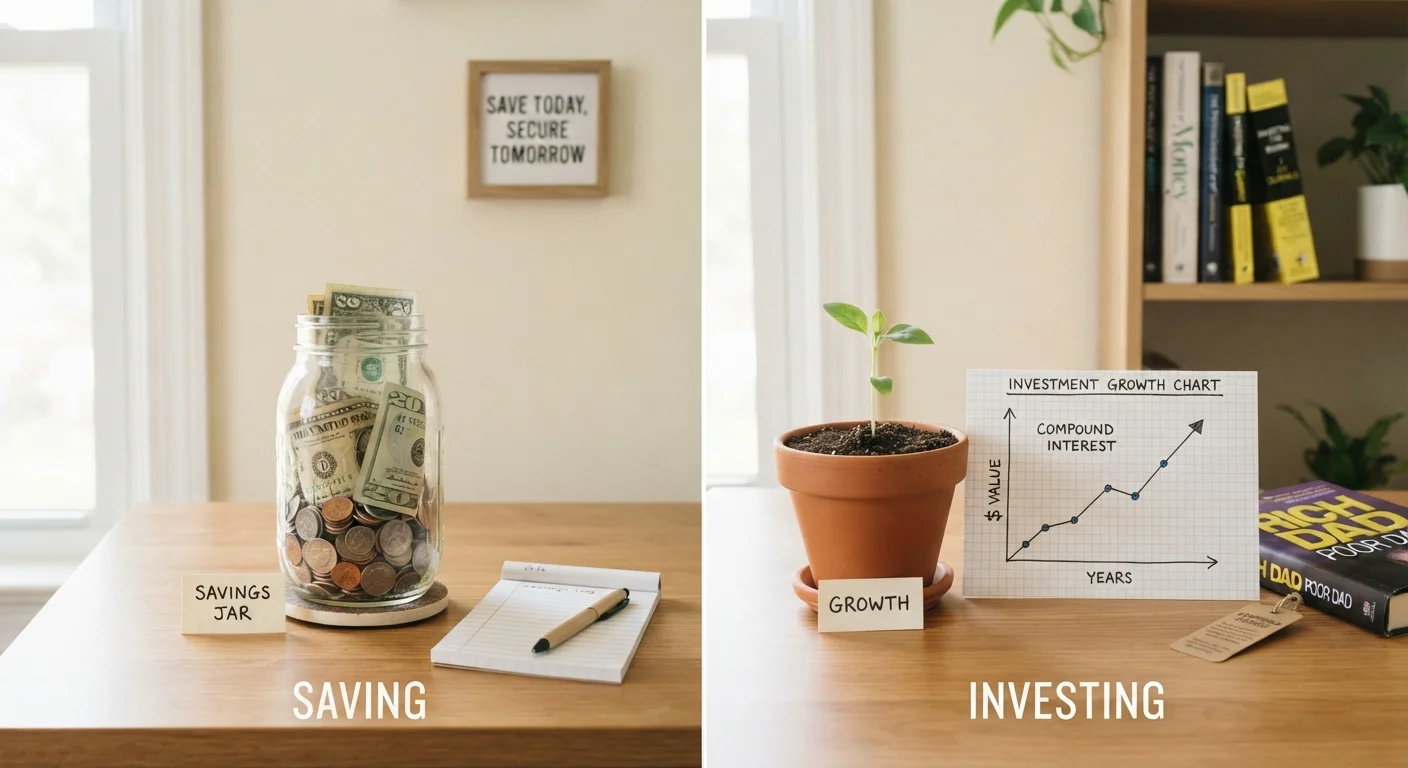
What Each Term Actually Means
Saving means setting aside money in a stable, low-risk account — typically a savings account, money market account, or certificate of deposit (CD). The goal is to preserve the principal (the original amount deposited) while keeping the money accessible. Returns are modest and predictable, usually tied to prevailing interest rates.
Investing means putting money into assets — such as stocks, bonds, index funds, or real estate — with the expectation that the value will grow over time. That growth potential comes with risk: the value of investments can fall as well as rise, and there is no guarantee of return. Past performance does not predict future results.
The core distinction is the trade-off between safety and access versus growth potential and risk. Neither approach is universally superior — the right tool depends entirely on your goal, timeline, and current financial stability. For a deeper look at how common beliefs about saving can mislead people, see common savings myths worth understanding.
| Criterion | Saving | Investing |
|---|---|---|
| Primary goal | Preserve principal, stay liquid | Grow wealth over time |
| Risk level | Very low | Low to high, depending on asset type |
| Typical return | Modest; tied to interest rates | Potentially higher; not guaranteed |
| Best time horizon | Under 5 years | 10+ years |
| Access to funds | Immediate or near-immediate | Can take time to sell; value may fluctuate |
| Principal protection | Yes (within FDIC limits) | No guarantee; can lose value |
| Common accounts | Savings accounts, CDs, money market | Brokerage accounts, 401(k), IRA |
The Role of Time Horizon
Time horizon — how soon you need the money — is the most reliable way to decide which tool belongs in a given situation.
Money you will need within five years should generally be saved, not invested. That includes your emergency fund, a down payment for a future purchase, a planned home repair, or a car replacement fund. If a market downturn hit and you had six months to recover, you might be forced to sell investments at a loss to cover an immediate expense. Savings accounts prevent that outcome.
Money you will not need for ten or more years — most commonly retirement savings — can withstand market volatility and potentially benefit from compounding returns over time. The longer the timeline, the more time there is for short-term losses to recover and for growth to accumulate.
3–6 months
Recommended emergency fund coverage
The Consumer Financial Protection Bureau (CFPB) generally recommends keeping three to six months of essential living expenses in an accessible savings account.
~40%
Americans without $400 in emergency savings
Federal Reserve survey data has consistently found that a significant share of U.S. adults could not cover a $400 unexpected expense without borrowing or selling something.
Goals that fall in the middle — roughly five to ten years out — often benefit from a mixed approach, though the appropriate balance depends on individual circumstances. Consulting a licensed financial adviser can help you think through what makes sense for your situation. For practical guidance on structuring goals by timeline, see how to separate money by time horizon.
Putting It Into Practice as a Homeowner
Homeownership creates a specific set of financial demands that make the saving-versus-investing distinction especially relevant. Unexpected repairs, property tax bills, and insurance renewals can all require quick access to cash. Before directing surplus income toward investments, most financial guidance suggests establishing an emergency fund covering three to six months of essential expenses in a liquid savings account.
Once that foundation is in place, a structured savings plan for near-term home expenses — a maintenance fund, for example — keeps you from raiding investments or taking on debt when the water heater fails. Automating those contributions can make the habit sustainable. How savings automation actually works explains the practical mechanics and common pitfalls of setting this up.
Surplus money beyond those funded goals — especially within tax-advantaged accounts like a 401(k) or IRA — is generally where investing enters the picture. The key sequence: cover immediate needs, fund liquid savings goals, then direct long-term dollars toward investments. This is general information; a qualified financial professional can help tailor this sequence to your actual income, debt, and goals.
FDIC Insurance: What It Covers
Deposits in savings accounts at FDIC-member banks are insured up to $250,000 per depositor, per institution, per ownership category. This protection does not extend to investment accounts, brokerage accounts, or market-linked products. It's one of the key reasons savings accounts are considered lower risk than investments for money you cannot afford to lose.
This article is for general informational and educational purposes only and does not constitute personalised financial, investment, or tax advice. Please consult a licensed financial professional before making decisions about your specific situation.