
Why the Confusion Around Online Certificates Persists
The online learning market has expanded rapidly, bringing with it a bewildering mix of credentials: completion badges, micro-credentials, professional certificates, continuing education units, and industry certifications all coexist - often with little explanation of how they differ. Both employers and learners make costly assumptions about what these credentials mean, either dismissing them outright or over-relying on them. Getting clarity starts with understanding exactly what you're earning - and what the person reading your resume understands it to mean.
Myth
Employers don't take online certificates seriously - they're just participation trophies.
Fact
Employer perception varies widely by field, credential type, and issuing body; many hiring managers in tech, data, and project management actively look for relevant online credentials.
Blanket dismissal of online certificates ignores how the hiring landscape has shifted. Surveys from professional associations in technology and project management consistently show that demonstrated, applicable skills - regardless of delivery format - influence hiring decisions. What employers scrutinize is whether the certificate signals real competency: Who issued it? Does it require a rigorous assessment? Is it recognized within the industry? A certificate from a well-regarded university platform or a major technology company's training division carries far more signal than one from an obscure provider with no vetting process. The credential itself is a starting point; the skills and portfolio work behind it close the deal.
Myth
Free online certificates are worthless and show a lack of commitment.
Fact
Free certificates can demonstrate genuine initiative; what matters more is the rigor of the content and how well you can apply the skills learned.
Cost is a poor proxy for quality in online education. Several widely respected platforms offer free audit options for courses developed by major universities, and some provide free certificates through nonprofit or government-funded initiatives. What employers and graduate admissions committees actually evaluate is whether the learning translates to demonstrable ability. A free certificate in Python programming means little on its own, but paired with a portfolio of real projects, it becomes meaningful evidence of capability. That said, some industries and roles do expect paid, proctored credentials - knowing which applies to your target field is essential. Our plain-language glossary of credentials can help you parse the differences.
Myth
Online certificates are equivalent to a college degree and can fully replace one.
Fact
Online certificates and degrees serve different purposes; certificates validate specific skills while degrees signal broader academic achievement and are often required for certain roles or further education.
These credentials occupy different rungs on the qualification ladder and are rarely interchangeable. Degree programs involve sustained academic engagement, general education requirements, and institutional accreditation that opens doors to graduate school and many licensed professions. Certificates - even rigorous ones - are narrower by design. They are most powerful as complements to existing qualifications or as targeted credentials for career changers entering roles where specific technical skills are the primary hiring factor. In fields like nursing, law, or engineering, licensure requirements mean no certificate substitutes for the required academic credential.
Myth
Any certificate listed on LinkedIn automatically impresses recruiters.
Fact
Recruiters are increasingly credential-literate and look past the badge to evaluate the issuing body, the skills assessed, and how the credential fits the role.
As certificates have proliferated, so has recruiter skepticism about undifferentiated listings. A profile crowded with certificates from low-rigor sources can actually raise questions about judgment. Selective, well-contextualized credentials - especially those tied to recognized industry bodies or respected institutions - stand out more than volume. For roles in technology, finance, or project management, understanding what employers actually weigh helps you prioritize the credentials worth pursuing. Describing what you built or solved using the skills learned adds far more context than a badge alone.
Myth
All online certificate programs are essentially the same quality.
Fact
Quality varies enormously based on curriculum design, assessment rigor, instructor expertise, and whether the issuing body has industry or academic standing.
The online certificate market spans an enormous range - from rigorous, assessment-heavy programs developed with industry input, to lightly curated video playlists with auto-generated badges. Evaluating quality requires looking at: whether learning outcomes are clearly defined, how skills are assessed (quizzes vs. applied projects vs. proctored exams), the credentials and experience of instructors, and whether the issuing institution or organization has standing in your target field. For a structured look at credentials that consistently carry weight across major career fields, see our overview of high-value certifications across six career fields.
How to Choose Certificates That Actually Move Your Career Forward
Once you understand what online certificates can and cannot do, the practical question becomes: which ones are worth pursuing? The answer depends on your field, your existing qualifications, and what gap the certificate is meant to fill.
Certificate vs. Certification: A Critical Distinction
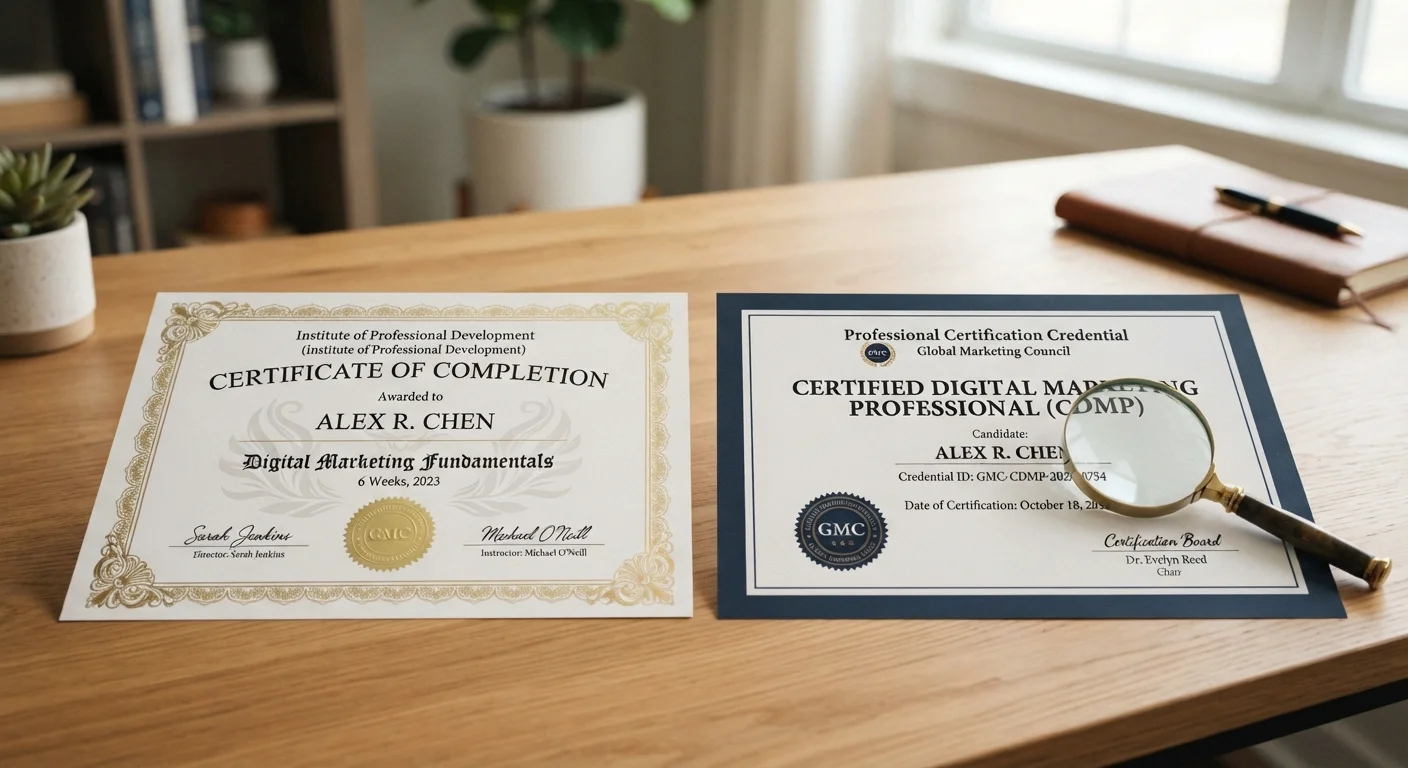
A course completion certificate simply confirms you finished a program. An industry certification - such as a PMP, CompTIA A+, or Google Data Analytics credential - typically requires passing a standardized exam and is governed by a credentialing body. Confusing the two on a resume can damage your credibility with experienced hiring managers. See the full breakdown in our guide to certificates vs. certifications.
Start by identifying whether your target role values a specific industry certification (which typically requires an exam) or whether a rigorous course certificate demonstrating applied skills will suffice. Research job postings for roles you want and note which credentials appear consistently. Then verify the issuing body's standing - not just its marketing claims. The Skills & Certifications hub is a useful starting point for navigating these decisions with confidence.
Verify Before You Invest Time and Money
Some online programs use accreditation-sounding language without holding recognized accreditation. Before enrolling in any paid certificate program, verify the issuing institution's accreditation status through official government or accrediting-body databases. Our article on how accreditation works walks you through exactly what to look for.
Finally, treat any certificate as one component of a broader evidence package. Employers respond to demonstrated ability: portfolios, projects, case studies, and the ability to discuss what you learned in an interview all carry weight alongside the credential itself.