
Why This Glossary Exists
Online education has expanded rapidly, and so has its vocabulary. Terms like badge, certificate, certification, and micro-credential are used interchangeably in marketing materials - but they describe meaningfully different things. Misreading a credential type before enrolling, or using the wrong term on a résumé, can cost real time and money.
This glossary is a reference tool, not a ranking. It defines the core terminology you'll encounter across platforms and industries so you can evaluate your options clearly. For a deeper look at how these credentials play out in hiring decisions, see what employers actually think about online certificates.
| Who governs professional certifications | Industry-specific associations (e.g., PMI, CompTIA, SHRM) |
| Standard CEU calculation | 1 CEU = 10 contact hours of approved instruction (International Association for Continuing Education and Training (IACET)) |
| Open Badges standard maintained by | 1EdTech (formerly IMS Global Learning Consortium) |
| Typical certification renewal period | Every 1-3 years, varies by credential and issuing body |
| U.S. regional accreditation bodies recognized | 7 bodies recognized by the U.S. Department of Education (U.S. Department of Education) |
Core Terms Defined
The definitions below cover the terms you are most likely to encounter when researching online learning programs. Each is written to be precise without being technical.
Certificate of Completion
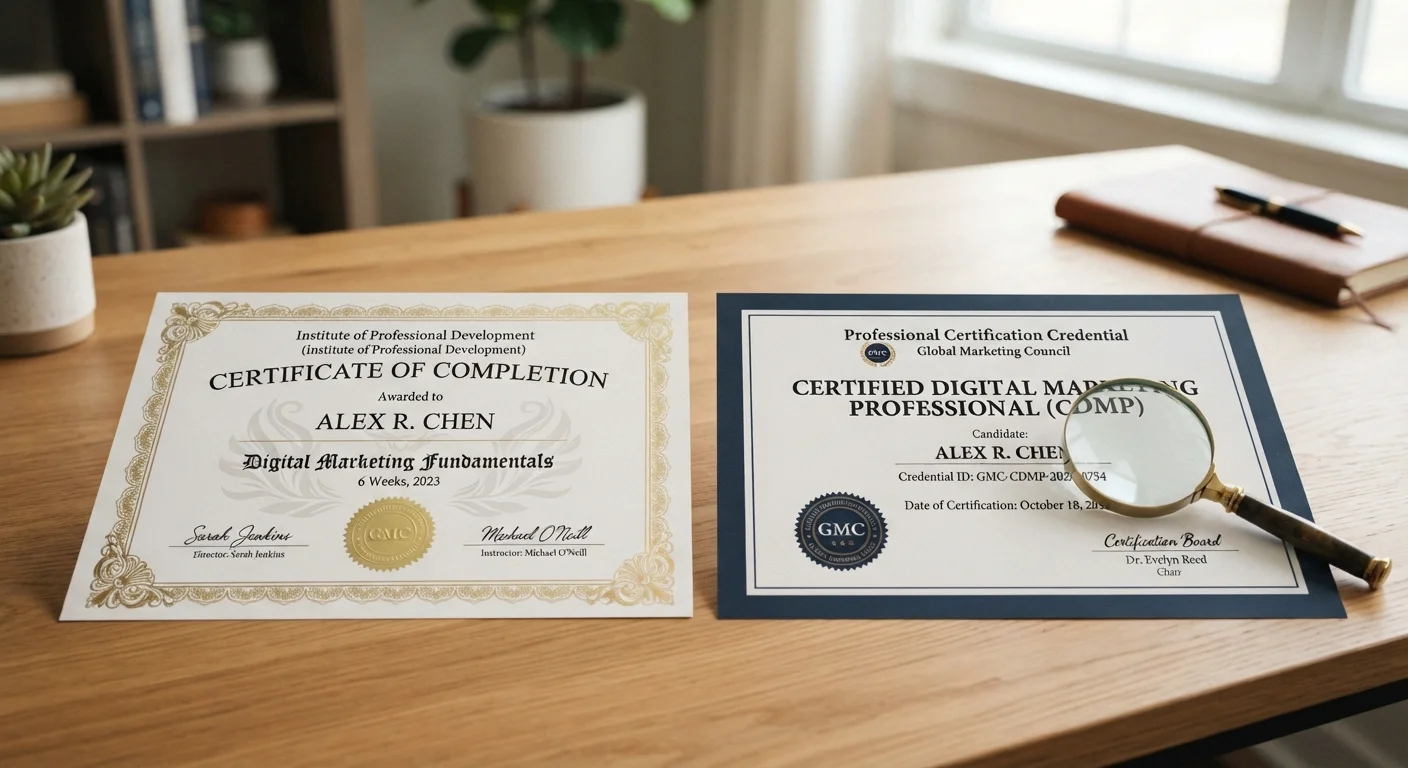
A document issued by a course provider confirming a learner finished a course or program. It signals participation and effort but is not the same as a professional certification - it carries no standardized external assessment or accreditation.
Professional Certification
A credential awarded by a recognized industry body after a candidate meets defined standards, typically including an exam and minimum experience requirements. It usually requires periodic renewal and carries more employer recognition than a completion certificate.
Micro-Credential
A short, focused credential that validates a specific, narrow skill or competency. Offered by universities, platforms, and industry groups, their value varies considerably depending on the issuing organization's reputation and the field.
Digital Badge
A verifiable, shareable image file - commonly following the Open Badges standard - representing a completed achievement. Badges embed metadata (issuer, date, criteria) so employers or platforms can verify them online.
Continuing Education Unit (CEU)
A standardized unit of measurement for non-credit professional development. One CEU generally equals ten contact hours of participation in approved instruction, and CEUs are often required to renew licenses or professional certifications.
Accreditation
A formal quality-assurance process by which an independent body evaluates whether an educational institution or program meets defined academic and operational standards. Accreditation affects credit transferability and degree legitimacy but does not automatically apply to individual online courses.
Stackable Credential
A series of credentials designed so each builds on the previous one, progressively advancing toward a larger qualification such as a degree or full professional certification. Stackable pathways let learners gain and apply skills in stages.
Credit-Bearing Course
A course that awards academic credit upon completion, which may be transferable to a degree program. Not all online courses are credit-bearing; learners should confirm credit status and transferability with both the provider and their target institution before enrolling.
Accreditation Applies to Institutions, Not Individual Courses
A common point of confusion: when a university holds accreditation, that status applies to its degree-granting programs - not automatically to every open online course or standalone certificate it offers. If you're enrolling specifically to earn transferable academic credit, confirm credit status and transferability with both the provider and your receiving institution before you pay. This distinction is most consequential for learners planning to apply coursework toward a degree.
For a side-by-side comparison of completion certificates and professional certifications - including how each is perceived by hiring managers - see our article on certificates vs. accredited certifications.
How These Credentials Connect
Understanding each term individually is useful, but the real clarity comes from seeing how they relate. A typical learning journey might look like this: a learner completes a short online course and earns a digital badge (a micro-credential). They later complete a structured program and earn a certificate of completion. After gaining work experience and passing a proctored exam, they earn a professional certification - which requires CEUs to renew every few years.
Not every path follows this sequence, and not every credential type suits every goal. Micro-credentials carry genuine value in some fields and limited recognition in others. Stackable credentials can serve learners who prefer to progress gradually without committing to a full degree upfront.
To understand what happens when credentials expire or renewal deadlines pass, see our guide on keeping certifications current. This glossary is also one component of a complete resource for continuous learners covering the full online learning journey. Whichever credential path you pursue, the underlying digital literacy competencies you build matter alongside any document you receive.
This article is for general informational and educational purposes only and does not constitute career, legal, or financial advice. Credential value varies by employer, industry, and region. Consult relevant professional associations or a qualified career adviser for guidance specific to your situation.