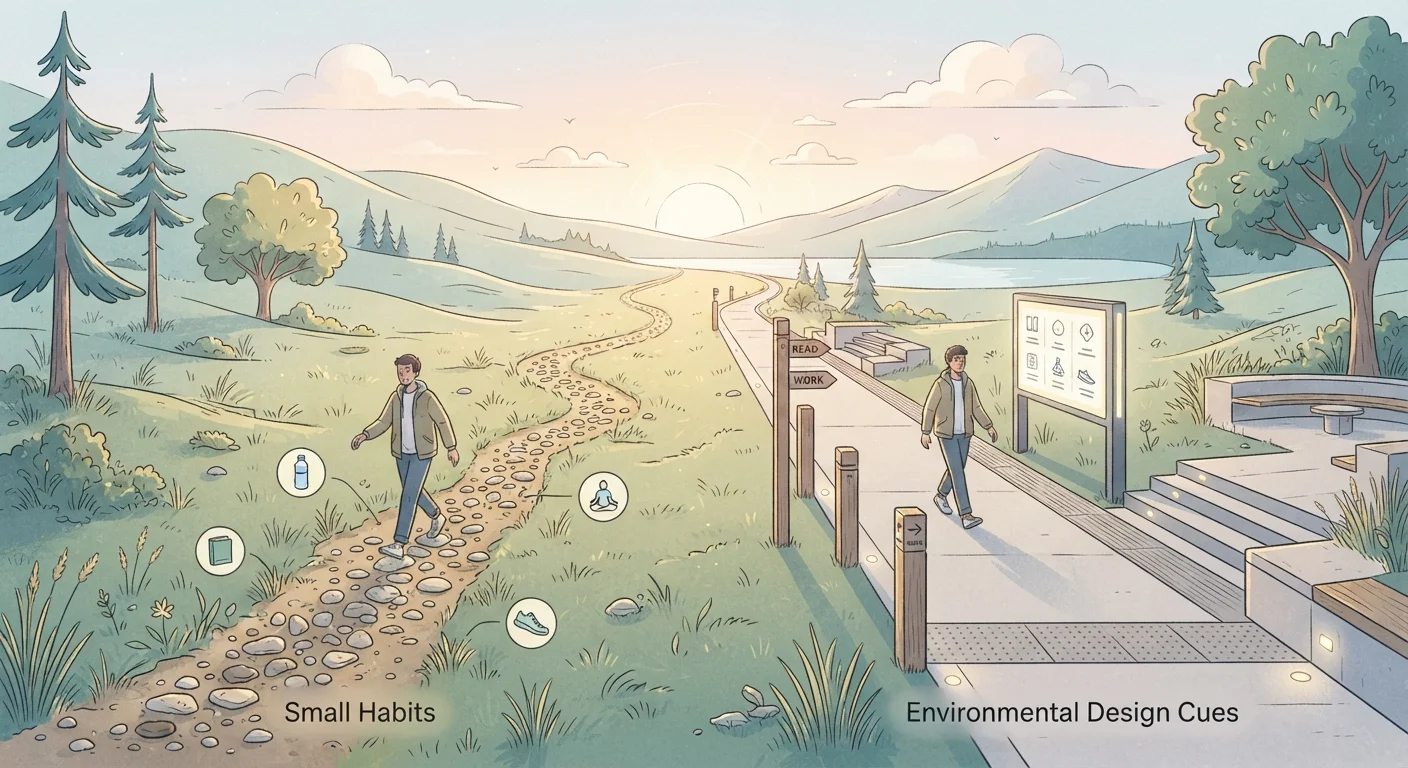

The Habit Loop: How Your Brain Automates Behavior
Behavioral science describes habit formation through a three-part cycle: a cue (the trigger), a routine (the behavior itself), and a reward (the reinforcing outcome). Each time this loop completes, the neural pathway associated with it is strengthened. Over repeated cycles, the brain's basal ganglia - the region governing procedural memory - begins to handle the behavior automatically, bypassing deliberate thought.
This is a feature, not a bug. Automaticity frees up cognitive bandwidth for complex decisions by offloading routine actions. The practical implication: if you want a behavior to stick, you need to give the brain a consistent cue and a reliable reward, not just good intentions.
“Habits are, simply, reliable solutions to recurring problems in our environment. Over time, your brain begins to automate behaviors that have reliably produced rewards - shifting them from effortful decisions to near-automatic responses.”
— Wendy Wood, Research psychologist and professor at the University of Southern California, author of research on habit and behavior change
How Long Habit Formation Actually Takes
The popular claim that habits form in 21 days originated from anecdotal observations - not controlled research. A more rigorous study by Phillippa Lally and colleagues at University College London tracked 96 participants forming real-world habits over 12 weeks. The data showed that automaticity developed anywhere from 18 to 254 days, with a median of approximately 66 days.
What drove the variance? Behavior complexity and consistency of context were the strongest predictors. Drinking a glass of water after waking automated far faster than completing a 30-minute workout. This matters for anyone building ambitious routines - patience and realistic expectations are part of the science, not optional add-ons.
66 days
Median time for habit automaticity
From a University College London study by Lally et al. tracking real-world habit formation across 96 participants.
18-254 days
Full range of habit formation timelines
The same UCL study showed wide individual variation depending on behavior complexity and consistency of context.
2x
Follow-through increase with implementation intentions
Research by psychologist Peter Gollwitzer found if-then planning roughly doubled the likelihood of acting on intentions across multiple studies.
Environment, Context, and the Role of Cues
One of the most robust findings in habit research is the power of context stability. When a behavior is performed in the same physical environment, at the same time, or immediately after the same preceding action, the environmental cues themselves begin to trigger the routine - reducing reliance on motivation.
This is why many behavioral scientists recommend habit stacking: anchoring a new behavior to an existing automatic one. A concrete example is placing a book on your pillow each morning so that bedtime reliably cues reading. The existing habit provides the cue; the new behavior inherits its automaticity over time.
Context also explains why habits often collapse during travel, moving, or major life transitions - the familiar cues disappear. Redesigning your environment to restore or replicate those cues is a faster recovery strategy than re-motivating yourself. See how these principles apply in practice with common patterns behind abandoned fitness routines.
Start With the Cue, Not the Motivation
Rather than trying to increase your motivation for a new habit, focus on identifying or designing a reliable cue. A consistent trigger - a time of day, a location, or a preceding action - does more work than enthusiasm over the long run. Once the cue-routine-reward loop fires enough times, the behavior begins to run itself.
Putting the Research to Work
Understanding the science is the foundation - applying it is where most people stall. Three research-supported strategies stand out:
- Implementation intentions: Commit to a specific when and where ("I will do X at Y time in Z location"). Studies by Peter Gollwitzer show these if-then plans significantly increase follow-through.
- Reducing friction: The fewer steps between you and a desired behavior, the more likely automaticity develops. Lay out workout clothes the night before; pre-portion ingredients for a healthy meal.
- Tracking without perfectionism: Monitoring behavior reinforces the reward component of the loop, but rigid streak-tracking can backfire. Missing one day and immediately resuming has negligible impact on long-term habit strength.
Whether you're building financial discipline or health routines, these mechanics operate the same way. The article savings habits that compound over time applies these same principles to money behavior. For a deeper look at two structured approaches to habit change, explore Atomic Habits and behavior design frameworks.