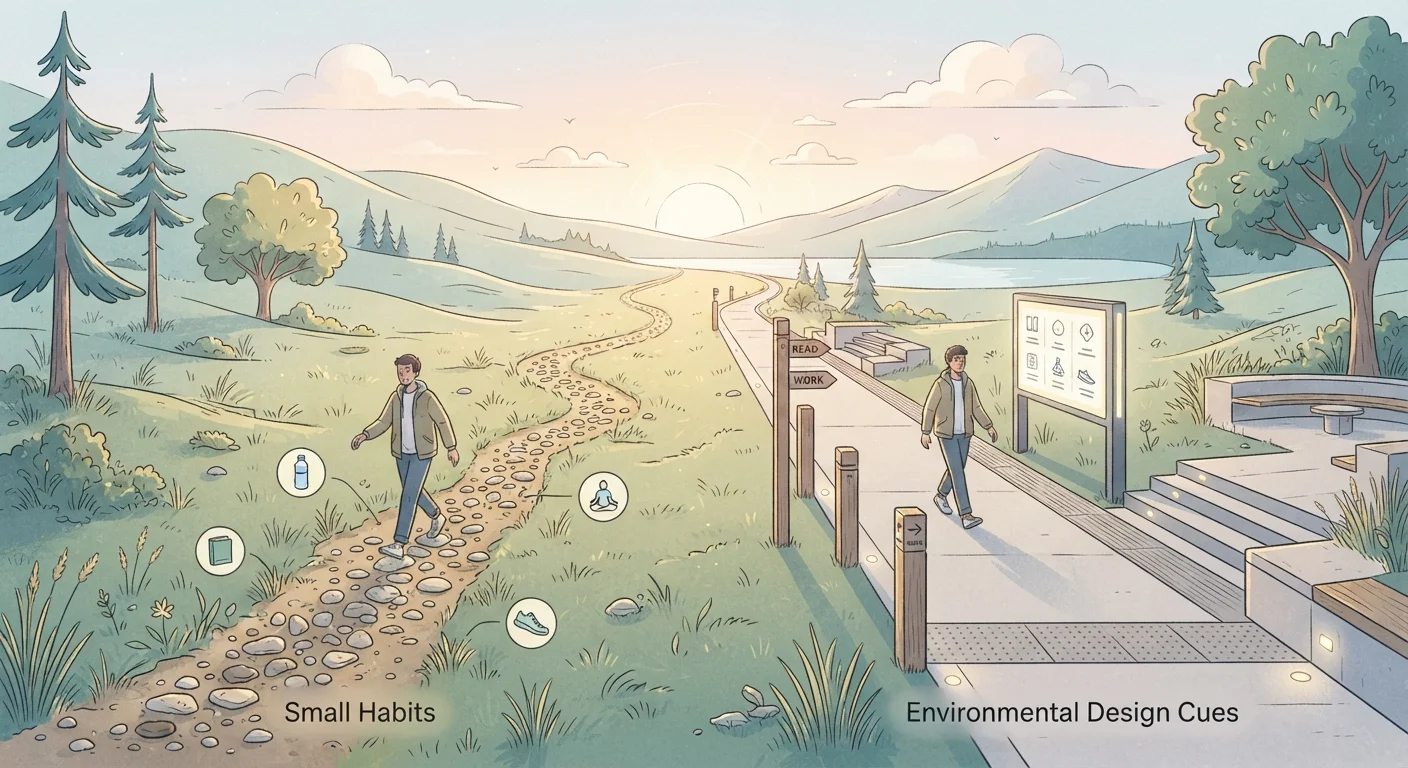

The Two-Week Wall Is Predictable - and Structural
Most habit breakdowns follow a surprisingly consistent timeline. The first few days feel energizing. By the end of week two, friction sets in, novelty fades, and the behavior quietly disappears. This is not a personal failure - it is a predictable phase of behavior change that behavioral science has documented repeatedly.
Understanding why this happens is the foundation for doing something different. To go deeper on the underlying mechanisms, see what research actually says about habit formation. The short version: habits become automatic through repetition in consistent contexts, and that process takes considerably longer than two weeks for most behaviors.
Willpower Is Not the Problem
Research in behavioral science consistently shows that self-discipline alone is a poor predictor of long-term habit maintenance. Habits that last are usually built on systems and environmental design - not personal resolve. If your habits keep failing, the structure needs adjusting, not your character.
The mistakes outlined below are not about character - they are about design. Each one is fixable with a specific, evidence-informed adjustment.
The Most Common Habit Design Errors
Starting too big, too fast - committing to a dramatic change that demands significant daily effort from day one.
Why it happens: Ambition is highest when a goal is freshest. The gap between aspiration and realistic capacity is easy to underestimate in the excitement of starting.
Relying entirely on motivation rather than building a supporting environment.
Why it happens: Most habit advice focuses on mindset, so people assume feeling motivated is the mechanism that keeps them going.
Treating one missed day as a sign that the habit has failed.
Why it happens: An all-or-nothing mindset is common - once the streak breaks, the habit feels psychologically "ruined."
Choosing a habit that is not meaningfully connected to a value or goal you actually hold.
Why it happens: Habits are often started because they seem like things a productive person "should" do, rather than because they align with genuine personal priorities.
Stacking too many new habits at once, spreading attention and energy across multiple behavior changes simultaneously.
Why it happens: New beginnings feel like an opportunity to overhaul everything at once, especially after a holiday, a birthday, or a difficult period.
Failing to attach the new habit to an existing anchor behavior or routine.
Why it happens: New habits are often planned in the abstract without being assigned a specific time, place, or trigger in daily life.
A useful companion lens here is the contrast between two structured frameworks for habit change - explored in detail in Atomic Habits and behavior design. Both frameworks emphasize systems over motivation, which maps directly to the errors above.
What Durable Habits Actually Look Like
Motivation Peaks Early - Then Drops Fast
The enthusiasm you feel in week one is real, but it is not sustainable fuel. Behavioral research suggests that motivation follows an arc: high at the start, lower once the novelty fades. Designing your habit so it does not depend on feeling motivated is essential for getting past the two-week mark.
Durable habits tend to share a few structural qualities: they are small enough to survive a bad day, anchored to an existing trigger, and connected to a purpose the person genuinely cares about. They also exist within an environment that makes the behavior easier than its alternatives.
This principle applies well beyond fitness and journaling. Keystone habits illustrate how one well-designed behavior can create positive ripple effects across entirely different areas of life - making it a particularly efficient starting point if you are only adding one thing at a time.
66 days
Average time for a habit to become automatic
A study published in the European Journal of Social Psychology found that habit automaticity took an average of 66 days to form - far longer than the commonly cited 21-day myth.
~2x
Effectiveness boost from implementation intentions
Meta-analyses on goal pursuit suggest that specifying when, where, and how a behavior will occur roughly doubles the likelihood of follow-through compared to intention alone.
If your habits have historically collapsed around the financial domain, why most budgets fail in month two covers the same structural dynamics applied to spending and saving behavior. The underlying mechanics are nearly identical.
This article is for general informational and educational purposes only. It does not constitute professional psychological, medical, or financial advice. Readers dealing with significant mental health concerns should consult a qualified professional.