
Why Your Score Varies by Lender
You check your credit score on your bank's app and see 720. You apply for a mortgage and the lender tells you your score is 698. Nothing happened in between — so what gives?
The answer lies in two separate realities: there are multiple scoring models, and those models draw on data from three separate credit bureaus — Equifax, Experian, and TransUnion. A lender can pull any combination of these. The score you saw on your bank app might be a VantageScore 3.0 based on your Experian file, while your mortgage lender pulled a FICO Score 5 from your Equifax file. Same person, genuinely different numbers.
Understanding your credit report's contents is the first step, because every score is built on top of that underlying data. If the data differs slightly between bureaus — and it often does — the scores will differ too.
Your Score Is Always a Snapshot
Credit scores are recalculated each time a lender requests them, using the data on your report at that exact moment. There is no single stored number that follows you around — it's generated fresh from your current credit file. This is why scores can shift from week to week as balances are paid down or new information is reported.
How FICO Scores Are Calculated
FICO (Fair Isaac Corporation) introduced the first broadly adopted credit score in 1989. Most mortgage lenders in the U.S. still rely on a FICO model, and the company releases new versions periodically — FICO 8 is the most widely used today, though FICO 9 and FICO 10 exist.
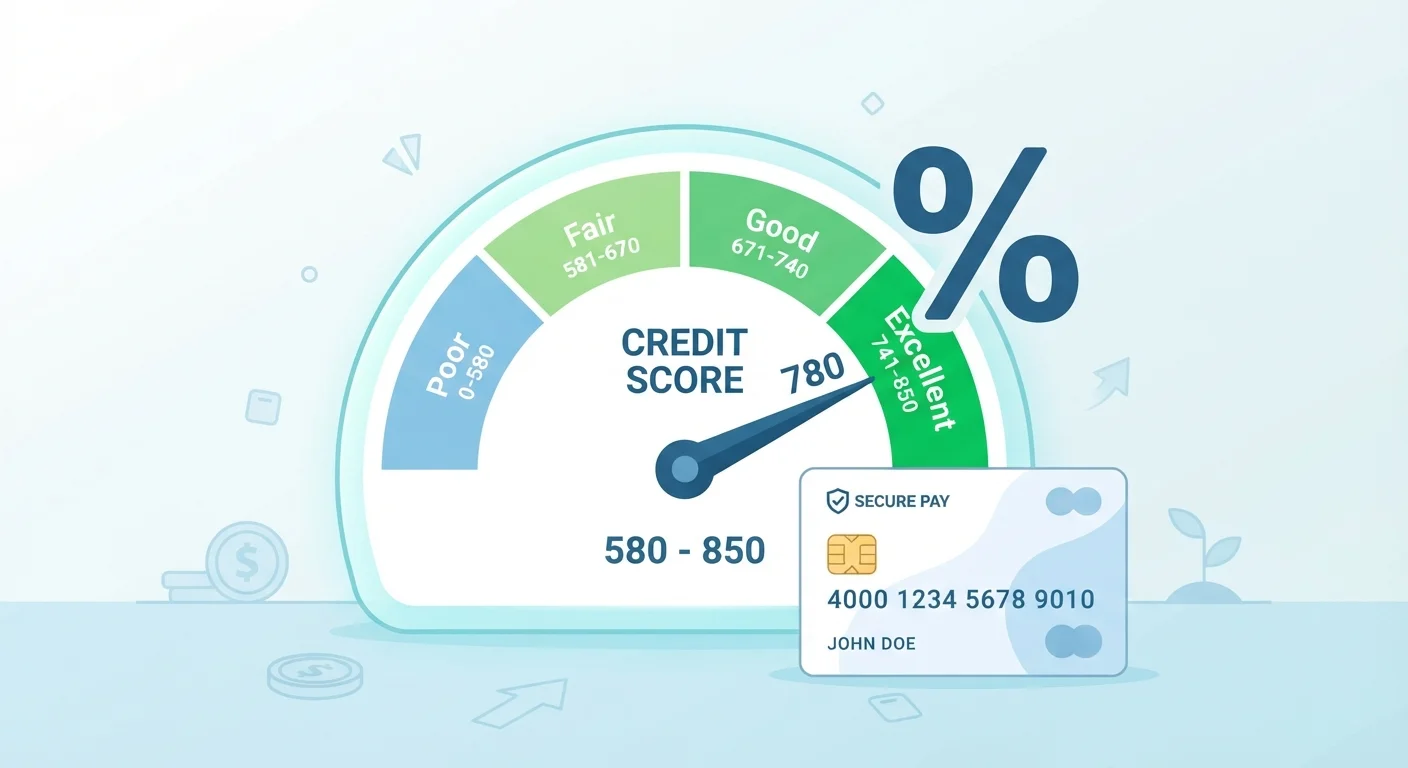
FICO scores range from 300 to 850 and weight five factors:
- Payment history (35%): Whether you pay on time. A single 30-day late payment can cause a notable drop.
- Amounts owed / utilization (30%): How much of your available revolving credit you're using. Keeping this ratio low matters significantly — see our guide on how credit utilization works.
- Length of credit history (15%): How long your accounts have been open on average.
- Credit mix (10%): Whether you have a variety of account types (cards, installment loans, etc.).
- New credit (10%): Recent hard inquiries and newly opened accounts.
FICO requires at least six months of credit history and at least one account reported within the past six months to generate a score.
When preparing to apply for a mortgage, pull your credit reports from all three bureaus at least 60 days in advance so you have time to dispute any errors before a lender runs a hard inquiry.
Mortgage lenders use all three bureau reports and the middle FICO score, so a single error at one bureau can be the difference between qualifying for a lower rate or being denied.
If a free score tool shows your VantageScore, treat it as directionally useful — not as a prediction of what a mortgage lender will see, which is usually a different FICO version entirely.
Consumers who don't understand this gap sometimes feel blindsided when a lender's score differs significantly from the one they've been tracking.
How VantageScore Works Differently
VantageScore was created in 2006 as a joint venture by all three major bureaus. It also uses a 300–850 range (since VantageScore 3.0), making direct comparisons easier on paper — but the underlying formulas differ in important ways.
VantageScore groups its factors somewhat differently:
- Payment history: Extremely influential
- Depth of credit (age and mix): Highly influential
- Credit utilization: Highly influential
- Balances: Moderately influential
- Recent credit: Less influential
- Available credit: Less influential
One meaningful practical difference: VantageScore 3.0 and later can score a consumer with as little as one month of credit history. This makes it more useful for evaluating younger borrowers or recent immigrants who don't yet qualify for a FICO score. VantageScore 4.0 also incorporates trended data — looking at whether balances are rising or falling over time, not just a snapshot — which FICO 8 does not.
Many free credit score tools (credit card apps, personal finance platforms) display VantageScore. That's worth keeping in mind when you're trying to anticipate what a lender will see.
Which Score Do Lenders Actually Use?
It depends heavily on the type of credit you're applying for.
Mortgages: Federal agencies Fannie Mae and Freddie Mac have historically required specific older FICO versions — FICO 2 (Experian), FICO 5 (Equifax), and FICO 4 (TransUnion) — and lenders pull all three, typically using the middle score. Regulatory updates are gradually expanding accepted models, but FICO remains dominant here.
Auto loans and personal loans: Lenders vary widely. Some use FICO Auto Scores (industry-specific variants), others use FICO 8 or VantageScore 3.0. There's no single standard.
Credit cards: Issuers frequently use FICO 8 or FICO Bankcard Scores, though VantageScore adoption is growing.
Because you can't always know which model a lender will use, the practical takeaway is to focus on the behaviors that improve your score across all models rather than optimizing for one specific version. If you want to understand exactly what data a lender is evaluating, reading your credit report before you apply is always a smart move.
90%+
Top U.S. lenders using FICO scores
FICO reports that more than 90% of top lenders use FICO scores in their credit decisions, making it the dominant model for high-stakes lending.
300–850
Score range for both FICO and VantageScore 3.0+
Both models share this range, but identical numbers don't mean identical risk assessments — the underlying formulas differ meaningfully.
35%
Weight of payment history in FICO score
Payment history is the single largest factor in FICO's formula, underscoring why even one missed payment can have an outsized negative impact.
What You Can Do to Improve Any Score
Because FICO and VantageScore respond to the same underlying credit behaviors, the levers you pull are consistent regardless of which model a lender uses:
- Pay on time, every time. Payment history is the top factor in both models. Set up autopay for at least the minimum due so you never miss a due date.
- Keep utilization below 30% — ideally below 10%. This means not carrying large balances relative to your credit limits. Paying down balances before the statement closes can help, since that's when issuers typically report to bureaus.
- Don't close old accounts unnecessarily. Older accounts lengthen your average credit age and maintain available credit, both of which help your score.
- Limit hard inquiries. Each application for new credit triggers a hard inquiry. Rate-shopping for mortgages or auto loans within a short window (14–45 days depending on the model) is generally treated as a single inquiry.
- Dispute errors promptly. Inaccurate negative information on your report can drag down scores across all models. You're entitled to free annual reports from each bureau at AnnualCreditReport.com.
There are also persistent myths worth clearing up before they lead you astray — things like whether carrying a balance helps your score (it doesn't). Our companion piece on credit score myths addresses the most common ones directly.
This article is for general informational and educational purposes only and does not constitute personalized financial or credit advice. For guidance specific to your situation, consider consulting a nonprofit credit counselor or licensed financial professional.