
Why One Savings Account Isn't Enough
Most people start with a single savings account attached to their checking. Money goes in, money comes out, and after a few months it's genuinely hard to say whether the balance represents an emergency fund, a vacation fund, or just a vague sense of security. That ambiguity is the problem.
When savings are pooled, every dollar competes with every other goal. A roof repair feels equally valid as a reason to withdraw as a planned vacation — because both are technically sitting in the same pot. Separating funds by purpose removes that conflict entirely.
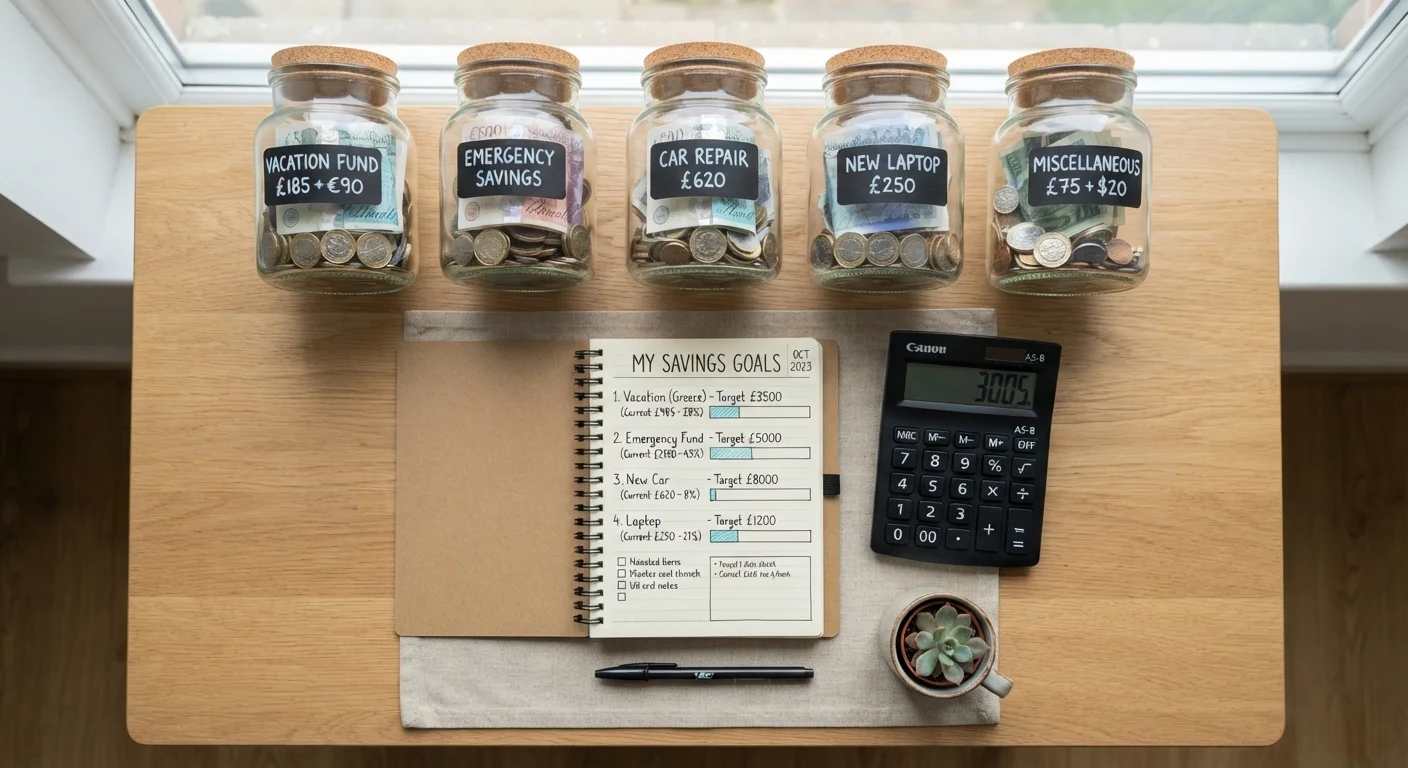
This approach, often called goal-based saving or the bucket method, works by giving each financial objective its own dedicated account. You can see exactly how far along you are on each goal, and spending from one bucket doesn't erode progress on another.
For young homeowners managing a mortgage alongside other life expenses, this structure is especially useful. See our guide to saving while carrying a mortgage for a complementary framework.
Name Your Accounts Specifically
Generic labels like "Savings 2" make it easy to rationalize withdrawals for unrelated expenses. A label like "Roof Repair Fund" creates a concrete mental association that discourages casual spending. Most banks let you rename sub-accounts in just a few clicks through their online dashboard.
What You'll Need Before You Start
Setting up a multi-account savings system doesn't require a financial adviser or any special tools — but a few things will make the process much smoother.
What you will need
Once you have these in place, the setup itself takes under an hour. The bigger investment is the upfront thinking: getting honest about what you're saving for and when you'll need it.
Step-by-Step: Structuring Your Savings Goals
Follow these steps to build a clear, automated savings structure that keeps every goal visible and funded.
List every savings goal you currently have
Write down every financial goal on your radar — home renovation, emergency fund, vacation, new appliance, property tax reserve, and anything else. Don't filter yet. Getting everything onto paper first prevents you from unconsciously underfunding a goal because it felt less important in the moment.
Assign a target amount and deadline to each goal
For each goal, estimate two things: how much you need in total, and when you need it. A kitchen renovation might require $12,000 in 18 months; a vacation might need $3,000 in 9 months. Divide the target by the number of months remaining to get your required monthly contribution.
- Short-term goals (under 12 months): vacation, appliances, annual insurance premiums
- Medium-term goals (1–3 years): renovation projects, car replacement fund
- Long-term goals (3+ years): major additions, investment property down payment
Open a separate account for each goal
Most banks and credit unions allow multiple savings sub-accounts at no additional cost. Open one account per goal and name it explicitly — "Emergency Fund," "Kitchen Remodel 2026," "Family Vacation." The label matters: behavioral research consistently shows that named accounts reduce the likelihood of unplanned withdrawals compared to numbered accounts.
Check that your institution offers this feature before assuming. Some online-only banks are particularly well-suited to this approach because they allow many sub-accounts and display goal progress visually.
Rank your goals by urgency, not emotion
If your monthly surplus is limited, you can't fully fund every goal simultaneously. Rank goals by two criteria: how soon you need the money, and what happens if you fall short. An underfunded emergency fund carries far more risk than a delayed vacation. Fund essentials first, then layer in discretionary goals with whatever remains.
The Life Milestone Savings framework provides a useful map for sequencing goals across different time horizons.
Automate a fixed transfer to each account on payday
Schedule automatic transfers from your checking account to each savings sub-account to trigger on or just after your pay date. Treating contributions as non-negotiable recurring expenses — rather than discretionary transfers — is the single most reliable way to build savings momentum. Set each transfer amount based on the monthly contribution you calculated in Step 2.
Review and rebalance every quarter
Set a recurring calendar reminder every three months to check each account balance against its target pace. Life changes — income shifts, unexpected expenses, revised goals — and your allocations should reflect that. A quarterly review keeps the system honest without requiring constant attention.
If a goal is consistently underfunded, either extend the deadline, reduce the target, or identify a spending category to trim. Avoid the temptation to borrow from one account to cover another — that defeats the structural purpose entirely.
Once your system is running, consider reading about how savings automation actually works — including common timing mistakes that can derail even well-designed setups.
Don't Spread Yourself Too Thin
Managing more than five or six active savings goals simultaneously can make progress feel invisible — especially when contributions are small. If monthly surpluses are limited, focus on two or three core goals and add others only as your financial picture improves. A system you can maintain is always better than an ambitious one you'll abandon.
It's also worth understanding the boundaries between goal types. Your emergency fund and travel fund, for example, serve completely different purposes and should never share an account. See our article on travel fund vs. emergency fund for a deeper explanation.
This article is for general informational and educational purposes only and does not constitute personalized financial advice. Consult a qualified financial professional for guidance specific to your situation.