Why Tire Maintenance Matters More Than Most Drivers Think
Tires are the only part of a vehicle that actually touches the road, making them central to braking, handling, and ride stability. Yet tire care is one of the most commonly deferred maintenance tasks among everyday drivers. The consequences go beyond worn rubber - improperly maintained tires reduce fuel economy, shorten tread life, and increase the risk of dangerous blowouts or loss of vehicle control.
Understanding a few core practices - pressure checks, tread inspection, rotation, alignment, and balancing - gives any driver the foundation to protect both their safety and their wallet. As part of a broader set of habits that extend a car's life, tire maintenance pays measurable dividends over time.
~11%
Fuel economy loss from underinflated tires
The U.S. Department of Energy estimates underinflation by 1 PSI in all four tires can reduce fuel economy by about 0.2%, with cumulative losses compounding across significant underinflation.
4/32"
Recommended minimum tread depth for wet roads
Many tire safety organizations recommend replacing tires at 4/32 of an inch, well before the legal minimum of 2/32 inches, to maintain wet-road traction.
1 PSI
Pressure drop per 10°F temperature decrease
According to the Tire Industry Association, tire pressure drops approximately 1 PSI for every 10-degree Fahrenheit drop in ambient temperature.
Tire Pressure: The Most Overlooked Safety Check
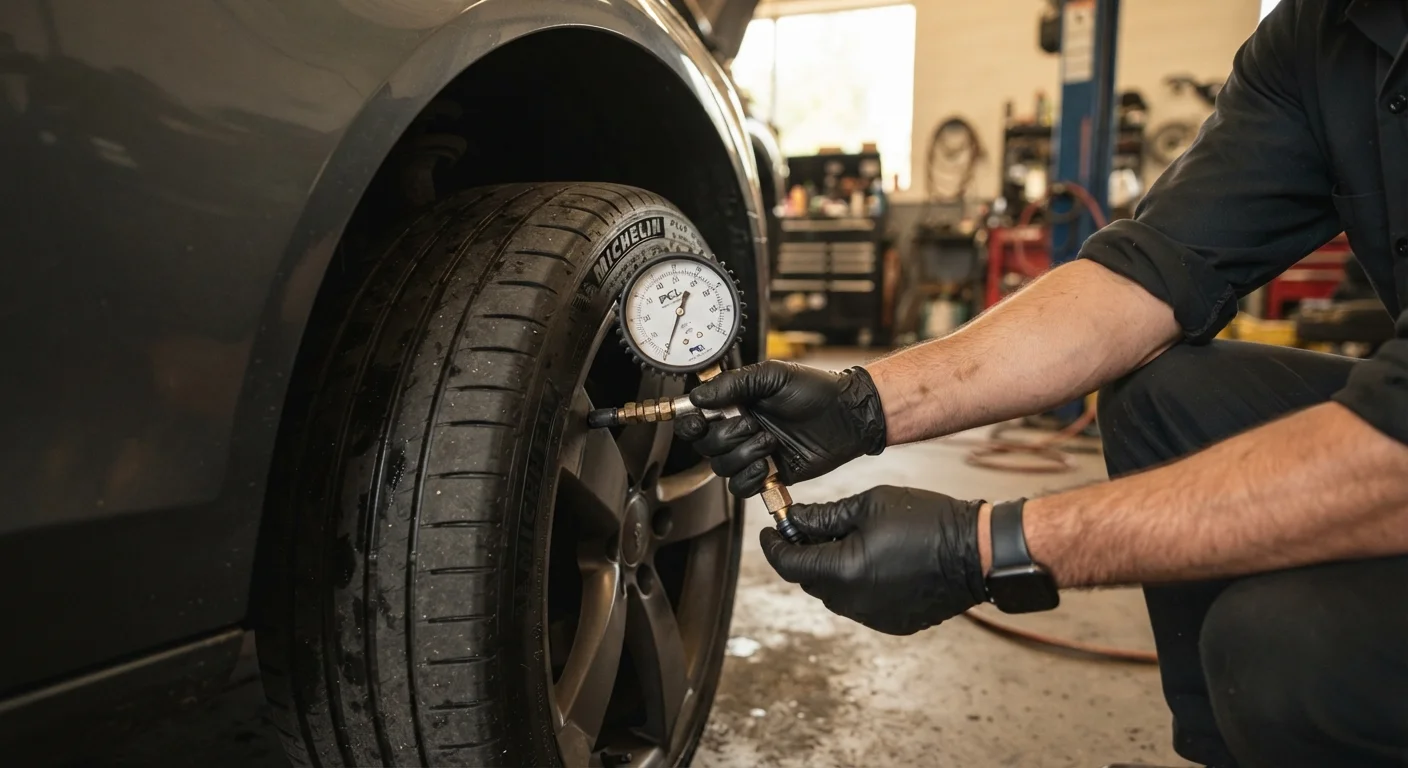
Tire pressure is measured in PSI (pounds per square inch). The correct pressure for your vehicle is printed on a sticker inside the driver's door jamb - not on the sidewall of the tire, which lists the tire's maximum rated pressure, not the recommended operating pressure. These two numbers are often confused and can differ significantly.
Underinflation is the more common problem. It increases rolling resistance, reduces fuel efficiency, causes uneven wear along the outer edges of the tread, and generates excess heat - a leading cause of tire failure. Overinflation creates a smaller contact patch with the road, reduces traction, and makes tires more vulnerable to impact damage from potholes or debris.
Check pressure when tires are cold - before driving more than a mile or two - since heat from driving temporarily increases PSI readings. Monthly checks are a reasonable baseline; check more frequently in winter, when cold temperatures cause pressure to drop (roughly 1 PSI per 10°F drop in temperature).
Use the Door Placard, Not the Tire Sidewall
The PSI number molded into a tire's sidewall is the maximum pressure the tire can hold - not the recommended operating pressure for your vehicle. Always inflate to the number shown on the sticker inside the driver's door jamb or in the owner's manual. Using the wrong reference can lead to overinflation, reduced traction, and a harsher ride.
Tread Depth: When to Replace, Not Just Rotate
Tread depth is what channels water away from the tire's contact patch, preventing hydroplaning on wet roads. The legal minimum tread depth in the U.S. is 2/32 of an inch. Most safety experts recommend replacing tires at 4/32 of an inch, particularly in climates with regular rain or snow.
A quick check: insert a quarter into a tread groove with Washington's head facing down. If you can see the top of his head, the tread is at or below 4/32 inches - a sign to start planning for replacement. The classic penny test (which flags 2/32 inches) indicates the tire is already at its legal limit.
Also inspect for sidewall cracking, bulges, or embedded objects. A bulge in the sidewall signals internal structural damage and is a reason to stop driving on that tire and have it evaluated by a mechanic immediately.
Tires at 2/32" Are Already at the Legal Limit
Many drivers wait for the penny test to show Lincoln's head fully visible before replacing tires - but at that point, the tread is already at the legally unsafe minimum of 2/32 inches. Wet stopping distances increase dramatically at this depth. Use the quarter test (Washington's head) as your action threshold for planning a replacement, not as confirmation that you've already waited too long.
Tire Rotation: A Simple Step That Extends Tread Life
Front and rear tires wear at different rates. On front-wheel-drive vehicles, front tires handle steering, braking, and propulsion simultaneously, causing them to wear faster. On rear-wheel-drive vehicles, the reverse pattern applies. Even all-wheel-drive vehicles develop uneven wear patterns without regular rotation.
Rotation moves each tire to a different position on the vehicle - typically front-to-rear, crossed, or in a pattern specified by the vehicle manufacturer - so wear distributes more evenly across all four tires. Most manufacturers and tire industry guidelines recommend rotation every 5,000 to 7,500 miles, often aligned with oil changes for convenience.
Skipping rotations shortens tire lifespan and can void some tire warranties. The real cost of skipping routine maintenance becomes clear when a full set of tires needs early replacement - a preventable expense that rotation helps delay.
When scheduling a tire rotation, ask the shop to inspect brake pad thickness at the same time - wheels are already off, and it costs nothing extra to look.
Combining inspections during the same service visit maximizes value and ensures small problems are caught before they escalate.
Keep a small digital tire gauge in your glove box and get in the habit of checking pressure the first cold morning of each month - it takes less than two minutes for all four tires.
Cold mornings reveal true resting pressure without heat-related inflation, giving the most accurate reading for comparison against the door placard specification.
Wheel Alignment and Balancing Explained
Alignment and balancing are distinct services that address different issues, though both affect how tires wear and how the vehicle handles.
Wheel alignment refers to the angles at which tires contact the road. Misalignment - often caused by hitting a pothole, curb, or other road hazard - causes tires to wear unevenly (feathering or one-sided wear) and can pull the vehicle to one side. Alignment should be checked annually or any time the vehicle pulls noticeably or after a significant impact.
Wheel balancing corrects uneven weight distribution around the tire-and-wheel assembly. Imbalanced wheels cause vibration, typically felt through the steering wheel at highway speeds. Balancing is recommended when new tires are installed and whenever vibration issues appear.
Neither service is a DIY task - both require shop equipment. Knowing when to seek professional help is part of smart ownership; see our guide on DIY car maintenance vs. taking it to a mechanic for a framework on that decision.
Putting It All Together: Your Tire Maintenance Routine
A reliable tire maintenance routine doesn't require expertise - just consistency. Here's a simple framework:
- Monthly: Check all four tires (and the spare) for pressure, using a quality gauge.
- Every 5,000-7,500 miles: Rotate tires per your vehicle manufacturer's recommendation.
- Every 6-12 months: Visually inspect tread depth, sidewall condition, and look for signs of uneven wear.
- Annually or after impacts: Have alignment checked by a shop.
- With new tires or when vibration starts: Get wheels balanced.
These habits fit neatly into the broader set of smart habits that keep long-term car costs under control. And if some of what you've read here challenges what you thought you knew, you're not alone - car maintenance myths are remarkably persistent. Reliable tire care is less about technical skill and more about building a routine and trusting verified information over guesswork.