
Why Most Spending Trackers Fail
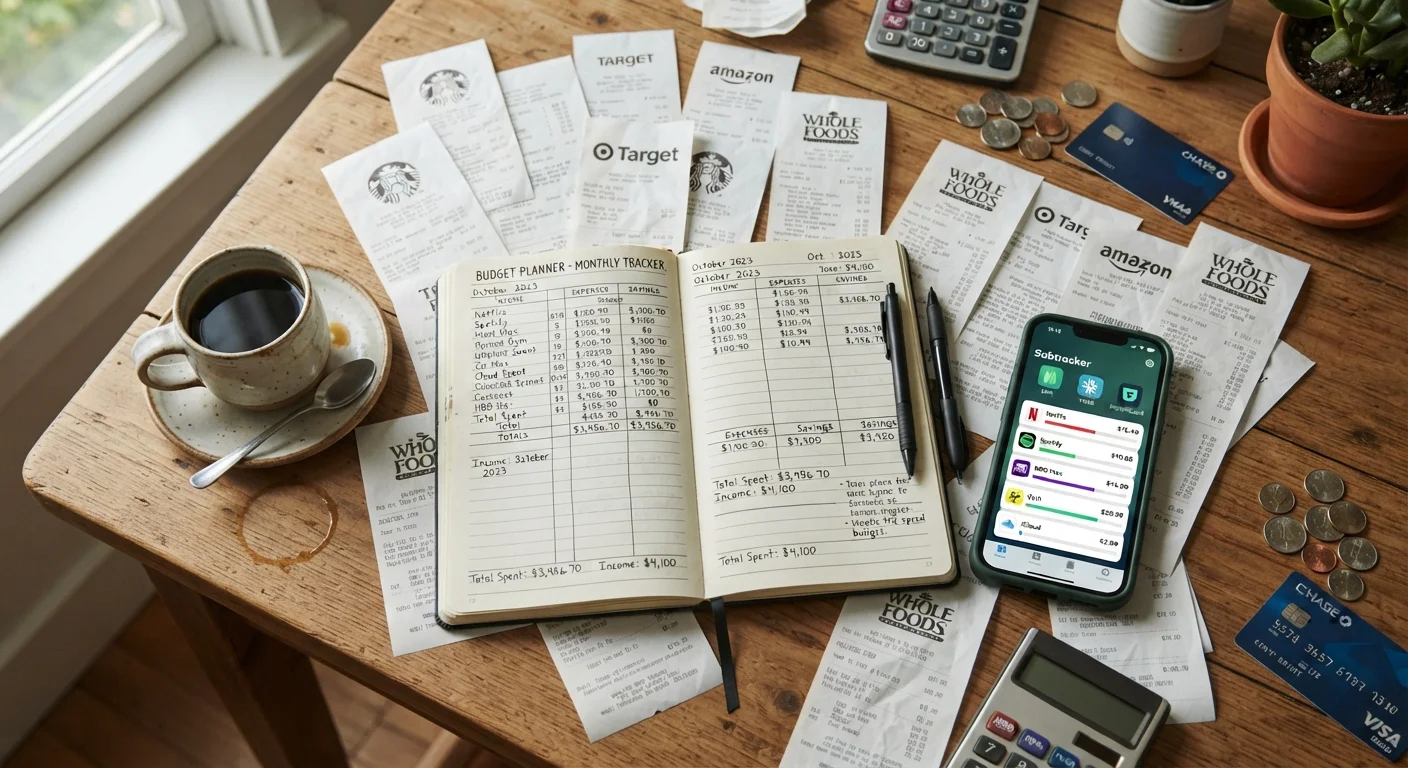
The most common reason people abandon spending trackers isn't laziness — it's that the system demands too much. Logging every $3 purchase, reconciling every receipt, and maintaining 15 categories feels like a part-time job. When the effort outweighs the insight, the habit disappears.
Effective tracking doesn't require perfection. It requires pattern recognition. You're not trying to account for every dollar; you're trying to understand where the majority of your money goes each month so you can make informed choices. A system you'll actually use consistently beats a theoretically perfect one you abandon by week three.
Use Your Bank's Built-In Tools First
Most major banks and credit unions already categorize your transactions automatically. Before downloading a third-party app, check whether your existing online banking dashboard has a spending summary — many do, and it requires zero setup.
Research in behavioral finance consistently shows that simply naming and tracking categories — without strict limits — increases financial awareness and reduces unconscious overspending. The act of looking is itself the intervention.
Tools and Setup
Bank or credit union online portal
Access transaction history and auto-categorized spending summaries without any additional setup.
Spreadsheet (Google Sheets or Excel)
Manually record and categorize monthly spending in a fully customizable, free format.
Free budgeting app
Automate transaction imports and category tracking via bank-linked accounts.
Printed or digital calendar
Schedule a recurring weekly money check-in so the habit becomes automatic.
What you will need
You don't need a paid subscription or complex software. The tools above cover the full range of needs from manual to automated. Start with what you already have access to — your bank portal is a zero-cost starting point. Once you've established a habit, you can evaluate whether a dedicated budgeting app adds enough value to be worth your time.
Step-by-Step: Build Your Tracking System
Follow the steps below to set up a low-friction spending tracker in a single session. After the initial 30–45 minutes of setup, ongoing maintenance should take no more than 10–15 minutes per week.
Pull 60 days of transaction history
Log into your bank and credit card accounts and download or view the last 60 days of transactions. You don't need to read every line yet — just get everything in one place. If you have multiple accounts, repeat for each one. This baseline is what you'll organize into categories.
Create five to seven broad spending categories
Resist the urge to build 20 granular categories. Instead, group spending into broad buckets that are easy to maintain: Housing, Transportation, Food & Groceries, Utilities & Subscriptions, Personal & Health, Entertainment, and Everything Else. Broad categories reduce the friction that kills most tracking attempts.
Assign each transaction to a category — once
Go through your 60-day transaction list and assign each item to one of your categories. Don't agonize over edge cases — a coffee on the way to a work meeting can go in either Food or Transportation; just pick one and stay consistent. The goal is a rough map of where money flows, not a forensic audit.
Identify your top three spending categories
Total each category and rank them. For most households, the top three categories account for 70–80% of discretionary spending. Knowing which categories dominate tells you exactly where small adjustments will have the biggest impact — and where obsessing over minor purchases is largely irrelevant.
Set a realistic monthly target for each category
Based on your averages from the past two months, set a loose monthly ceiling for each category. These aren't rigid limits — think of them as guardrails. If your Food & Groceries average was $520, a reasonable target might be $480–$500. Small reductions in large categories add up quickly over time. For a deeper look at where budgets quietly bleed, see common household spending leaks.
Schedule a 10-minute weekly check-in
Pick a consistent day and time — Sunday evening works well for many people — and spend about 10 minutes reviewing the week's transactions. Categorize anything new, check whether you're on pace with your monthly targets, and note any upcoming large expenses. This habit catches drift before it becomes a problem, without consuming your mental energy all week.
Do a monthly recap and adjust
At the end of each month, total each category and compare against your targets. Celebrate categories where you stayed on track. For any that ran over, ask one question: was it a one-time event or a pattern? Adjust your targets accordingly — your spending map should evolve with your life, not stay frozen. This iterative process is the foundation described in a complete personal budgeting resource.
This Is General Education, Not Personalized Advice
The methods described here are general financial education tools. Everyone's financial situation is different. For guidance tailored to your specific income, debts, or goals, consider consulting a licensed financial professional.
Keeping the Habit Without the Anxiety
Consistent tracking is most sustainable when it's tied to curiosity rather than judgment. The goal isn't to feel guilty about a restaurant dinner — it's to understand whether dining out represents 8% or 28% of your monthly spending, and whether that aligns with what matters to you.
Don't Let Perfect Be the Enemy of Done
Trying to log every single transaction often leads to burnout and abandonment. If you miss a few small purchases, your system hasn't failed — keep going. Consistency over weeks matters far more than precision on any given day.
If you find that your spending patterns extend into recurring subscriptions or automatic charges you'd forgotten about, that's worth a dedicated review. A focused audit of small but persistent household spending leaks can surface savings that don't require any lifestyle change at all.
Once you have a handle on your monthly spending, the natural next step is directing any freed-up funds toward specific goals. The Saving & Goals hub covers building an emergency fund and working toward longer-term milestones.
This article is for general informational and educational purposes only and does not constitute personalized financial advice. Consult a qualified financial professional for guidance specific to your situation.