
Why a Layered Savings Framework Works
Most people approach savings as a single pile of money competing against multiple demands. That approach tends to fail — a home repair drains the vacation fund, or a job disruption wipes out money earmarked for a renovation. A layered framework solves this by assigning every dollar a specific purpose, a specific account, and a specific timeline.
Think of it as stacking floors in a building. Each layer must be structurally sound before you add weight above it. For young homeowners managing mortgage payments, maintenance costs, and life milestones simultaneously, this structure is especially valuable. Before you build anything, though, start with a frank assessment of your cash flow and fixed obligations — our financial clarity checklist for homeowners walks you through exactly that groundwork.
56%
Americans unable to cover a $1,000 emergency
According to a Bankrate survey, more than half of U.S. adults could not pay a $1,000 unexpected expense from savings alone.
3–6 months
Recommended emergency fund coverage
Consumer finance guidance consistently recommends holding three to six months of essential living expenses in liquid savings.
21%
Homeowners who dipped into retirement savings for repairs
Research from the National Association of Realtors has found that a notable share of homeowners tap long-term savings to cover unexpected home costs.
Layer One: Your Emergency Buffer
Your emergency buffer is not a savings goal — it is financial infrastructure. Without it, every unexpected expense becomes a debt event. The standard guidance, supported by consumer finance research, is to hold three to six months of essential living expenses in a liquid, low-risk account such as a high-yield savings account or money market account.
As a homeowner, lean toward the higher end of that range. Homeownership introduces unpredictable costs — a failing HVAC system, a roof repair, a plumbing emergency — that renters don't face. A robust buffer keeps those events from cascading into credit card debt.
Never Count Your Emergency Fund as Savings
Your emergency buffer exists solely to absorb financial shocks — job loss, medical bills, urgent home repairs. Using it for planned expenses, even important ones, defeats its entire purpose and leaves you exposed when a real crisis hits. Treat it as untouchable unless a genuine emergency occurs, and replenish it immediately if you do draw it down.
Once your buffer is fully funded, resist the temptation to treat it as accessible savings. Keep it mentally and physically separate from your milestone accounts. For a deeper look at structuring multiple accounts without confusion, see our guide on goal-based saving across multiple accounts.
Layer Two: Short-Term Milestone Goals
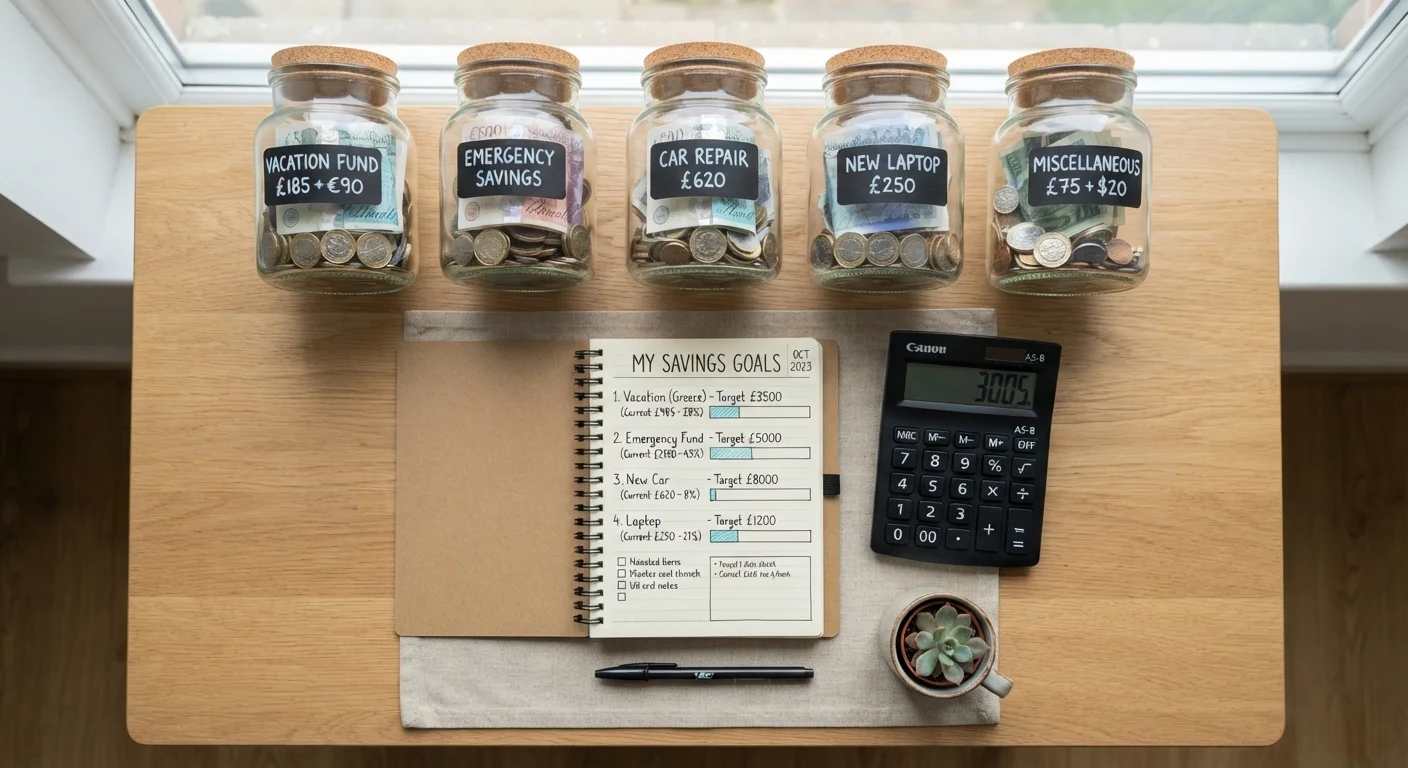
Short-term goals typically have a horizon of one to three years. Common examples for young homeowners include a home improvement project, a major appliance replacement, a vacation, or a vehicle down payment. Each deserves its own dedicated savings bucket — not a mental category, but a separate named account.
To set a realistic monthly savings target for any short-term goal, divide the total cost by the number of months until you need it. If you need $6,000 for a kitchen update in 24 months, that's $250 per month. Keep these funds in an account separate from your emergency buffer. Our article on structuring savings by time horizon explains why account separation is the key to keeping goals on track.
Name each savings account after its goal — 'Kitchen 2026' or 'Travel Fund' — rather than using generic labels. A named account creates a psychological commitment that makes you far less likely to raid it for something else.
Behavioral finance research consistently shows that labeling money for a specific purpose increases the likelihood that it will be preserved for that purpose.
When calculating your short-term savings target, add a 10–15% buffer to your cost estimate. Home projects and travel expenses almost always exceed initial projections.
Cost overruns are the norm rather than the exception in home improvement; building a cushion into the target prevents shortfalls without requiring a mid-project scramble.
For travel-related goals specifically, our travel budgeting hub offers frameworks for estimating and managing trip costs before you set a savings target.
Layer Three: Mid-Range and Long-Horizon Goals
Mid-range goals — roughly three to ten years out — might include a major home renovation, a career transition fund, or saving toward a child's education. Long-horizon goals extend beyond ten years and typically include retirement. These timelines allow for more growth-oriented vehicles (such as tax-advantaged retirement accounts), but the appropriate account types and risk levels depend on your individual situation. Consult a licensed financial adviser before making investment decisions.
The critical principle here is not to raid these accounts for short-term needs. That's why Layer One and Layer Two must be adequately funded first. A sound personal budget is the connective tissue that makes all three layers sustainable — if you haven't mapped your income to your obligations yet, our complete personal budgeting resource is the right starting point. The broader budgeting basics hub also offers accessible frameworks for day-to-day spending control.
Automating Your Progress
Automation removes the most common failure point in savings plans: the decision of whether to transfer money each month. Set up scheduled transfers from your checking account to each savings account on or just after your pay date, so the money moves before it can be spent.
Start small if your budget is tight — even $25 per month into a dedicated account builds the habit and creates visible progress. Increase transfer amounts whenever your income rises or a debt is paid off. Many employers also allow direct deposit splits across multiple accounts, which eliminates the intermediate step entirely.
The goal is to make saving the default behavior and spending the decision that requires conscious action — not the reverse.
Reviewing and Adjusting Over Time
A savings framework is a living document, not a set-and-forget system. Review your targets at least twice a year — and immediately after any major life change such as a job shift, a new dependent, or a significant home repair. Ask three questions at each review: Is my emergency buffer still adequate given my current expenses? Are my short-term goal timelines still realistic? Has my long-horizon situation changed in any way?
Personal and financial growth go hand in hand — if you're building broader life habits as a young adult, our personal growth framework for your twenties and thirties complements the financial discipline covered here.
Adjust contribution amounts as your life evolves. The framework is the structure; the numbers inside it should be updated to reflect reality.
This article is for general informational and educational purposes only and does not constitute personalized financial, investment, tax, or legal advice. Consult a qualified financial professional before making decisions about your specific financial situation.