
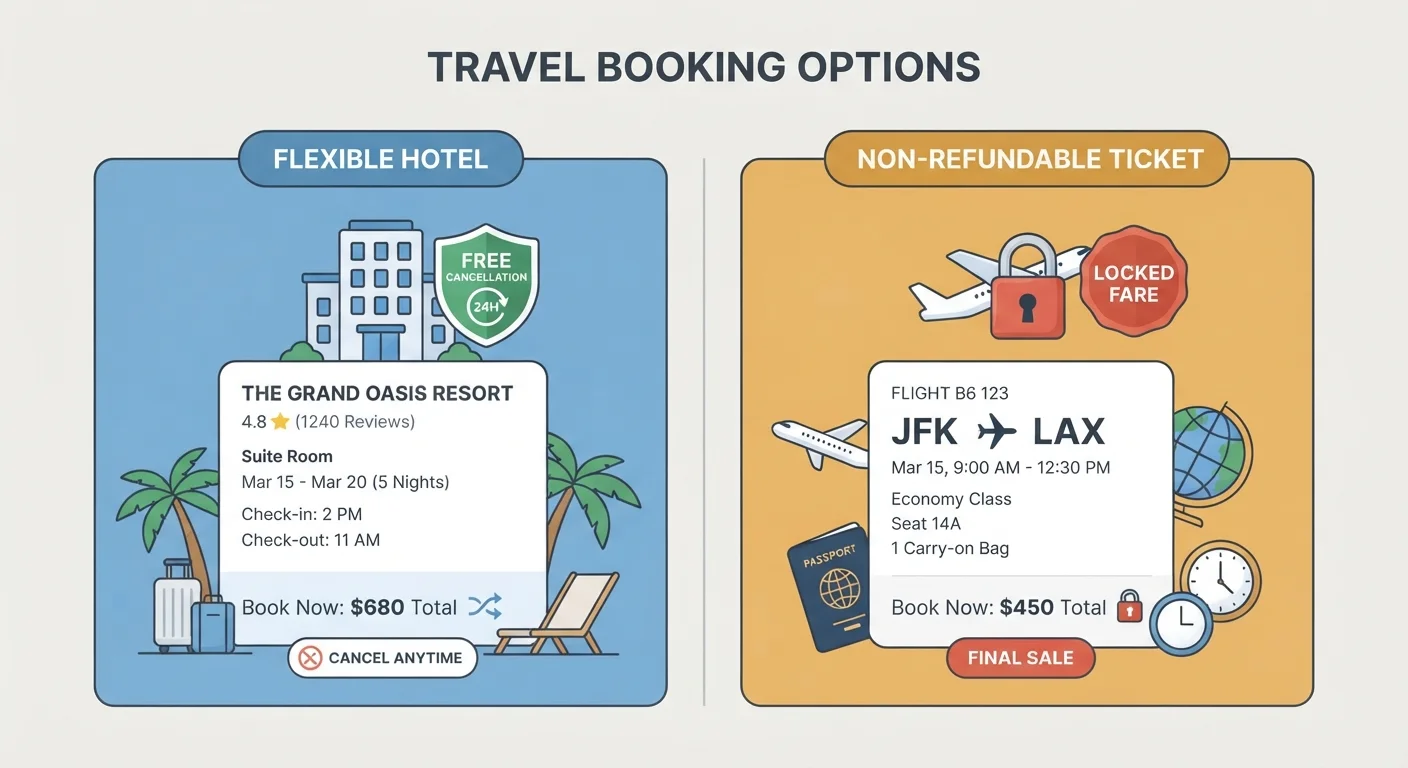
What These Two Rate Types Actually Mean
When you're shopping for flights or accommodation, you'll almost always encounter two pricing tiers: a lower non-refundable rate and a higher flexible (or refundable) rate. The names are fairly self-explanatory, but the details matter more than the labels suggest.
A non-refundable booking means that if you cancel — for any reason — you forfeit the amount paid. Some providers offer partial credit toward a future booking instead of a full refund, but that credit usually expires and may carry restrictions. A flexible rate allows you to cancel within a specified window (often 24–72 hours before check-in or departure) and receive a full refund to your original payment method.
What often catches travelers off guard is the middle ground: "partially refundable" or "free cancellation until " offers that revert to non-refundable terms as the travel date approaches. Always read the specific cancellation window before confirming. For a broader look at how accommodation choices affect your options, see our accommodation comparison guide.
The Case for Non-Refundable Rates
The primary argument is simple: you pay less. For popular routes and high-demand hotels, non-refundable rates can be 10–30% cheaper than their flexible counterparts. On a multi-night stay or a long-haul flight, that gap can represent hundreds of dollars — real money worth considering.
Lower upfront cost, sometimes significantly so
Non-refundable rates routinely run 10–30% below flexible equivalents, a gap that compounds across flights, hotels, and multi-night stays.
Ideal when travel dates are certain and firm
If work leave, event tickets, or group travel already locks in your schedule, paying for cancellation flexibility you won't use adds no real value.
Best available prices often come with non-refundable terms
Early-bird and promotional fares are typically non-refundable by design; accessing them means accepting those conditions.
Encourages commitment and reduces decision fatigue
Knowing you can't back out without a financial penalty can actually simplify planning by removing the temptation to endlessly second-guess a booking.
Non-refundable bookings also make sense when your trip is logistically locked in. If you've already taken time off work, coordinated with travel companions, and bought non-refundable event tickets at your destination, the booking is effectively committed anyway. Paying for flexibility you won't use is a poor trade.
Booking well in advance — where prices are often lowest — also tends to coincide with non-refundable terms. Understanding when to book is its own calculus; our guide on booking timing breaks down how lead time affects pricing across flights, lodging, and tours.
The Case for Flexible Rates
Flexibility has real monetary value — it's just harder to see until you need it. When something disrupts your trip (a medical issue, a family emergency, a visa delay, or even a severe weather event), the cost of a non-refundable booking that you can't use becomes very concrete, very fast.
No financial recovery if plans fall apart
Illness, family emergencies, or work conflicts can force a cancellation, and with non-refundable bookings, you typically lose the full amount paid.
Partial credits are often restricted and expire
When providers offer credit instead of a refund, those credits frequently come with short expiry windows, blackout dates, or route restrictions that limit their usefulness.
Locks in your itinerary even if better options emerge
If prices drop after you book or a better property becomes available, you can't rebook without losing what you already paid.
Stacks risk across a multi-component trip
When flights, accommodation, and tours are all non-refundable, one disrupting event can result in losing the entire trip's cost simultaneously.
Flexible rates also give you a strategic edge: if a better price emerges closer to your travel date, you can cancel and rebook without penalty. This is a common tactic among experienced travelers who book early to secure availability, then monitor for price drops. It requires some attention but can pay off.
For budget-conscious travelers, this kind of active management fits into a broader framework of understanding total trip costs. The real cost of a trip often includes expenses people didn't anticipate — a lost non-refundable booking is one of them.
Where Travel Insurance Fits In
Travel insurance is frequently marketed as the solution to this dilemma, but it's worth being precise about what it actually covers. A standard trip cancellation policy typically reimburses prepaid, non-refundable expenses if you cancel for a covered reason — usually serious illness, injury, death of a close family member, or certain natural disasters.
Flights and Hotels Play by Different Rules
Airlines and hotels handle cancellations very differently, and it's easy to conflate them. Many hotels offer free cancellation windows that genuinely result in full refunds; airline cancellation policies are often more restrictive, and "flexible" fares may only yield a travel credit rather than cash back. Always check the specific cancellation terms for each component of your trip independently rather than assuming one policy applies to everything.
"Cancel for Any Reason" (CFAR) add-ons offer broader coverage, typically reimbursing 50–75% of your prepaid costs regardless of why you cancel. They cost more and must usually be purchased within a short window of your initial booking deposit. Whether the added cost makes sense depends on how much non-refundable expense you're carrying and how uncertain your situation is.
The key takeaway: insurance can reduce — but not eliminate — the downside of non-refundable bookings. It introduces its own cost, its own paperwork, and its own claim process. It is not a substitute for reading cancellation terms carefully before you book. For a wider view on how individual booking decisions add up, see the trade-offs behind every budget travel decision.
10–30%
Typical savings on non-refundable vs. flexible rates
The price gap varies by property, route, and season, but this range is a commonly cited industry benchmark across hotel and airline pricing structures.
50–75%
Reimbursement rate for Cancel For Any Reason insurance
CFAR policies — a travel insurance add-on — typically cover this portion of prepaid, non-refundable costs regardless of cancellation reason, though terms differ by insurer.
How to Decide: A Practical Framework
Rather than defaulting to whichever rate appears first, run through a short checklist before confirming any booking:
- How certain are your dates? If your travel window is fixed and immovable, non-refundable is lower risk. If your schedule could shift, pay for flexibility.
- What is the price gap? A $15 difference on a $150 hotel night is 10% — meaningful. A $10 difference on a $500 flight is 2% — probably not worth the rigidity.
- What else is non-refundable in this trip? If you've already locked in expensive non-refundable components, adding more amplifies your total exposure.
- What's your financial cushion? Losing a $300 booking stings but is recoverable. Losing $1,800 in non-refundable flights and accommodation could derail other financial priorities.
- How far out are you booking? Plans are more likely to change the further ahead you're booking. This is also relevant to budgeting your trip realistically from the start.
No formula produces a guaranteed right answer, but working through these questions deliberately will consistently produce better decisions than chasing the lowest price by reflex.
This article is for general informational purposes only and does not constitute financial or travel advice. Cancellation policies, insurance terms, and pricing structures vary by provider and change over time. Always verify current terms directly with the provider before booking.