Why These Rules Carry Elevated Penalties
Most traffic violations result in a fine and a point on your license. But a handful of situations - school zones, active construction zones, and emergency vehicle encounters - are treated categorically differently by state law. Fines are often doubled or tripled, points are multiplied, and in some states a single violation can trigger a license suspension. The rationale is straightforward: these environments place vulnerable people - children, road workers, and first responders - in direct proximity to moving vehicles.
Understanding exactly what each rule requires isn't just about avoiding tickets. It's about operating your vehicle in a way that matches the genuine hazard. See how these situations compare to broader right-of-way expectations in our guide to right-of-way rules.
| Typical school zone speed limit | 15-25 mph (varies by state) (State DMV schedules) |
| School bus stop arm fine range | $250-$1,000+ (first offense) (Varies significantly by state) |
| Work zone speeding penalty | Double standard fine in most states (National Work Zone Safety Information Clearinghouse) |
| Move Over laws in effect | All 50 U.S. states (NHTSA and state statutes) |
| Typical Move Over fine (first offense) | $100-$500 (Varies by state) |
| Flagger legal authority | Equivalent to a traffic signal (MUTCD federal traffic control standards) |
School Zones: Speed, Signals, and Timing
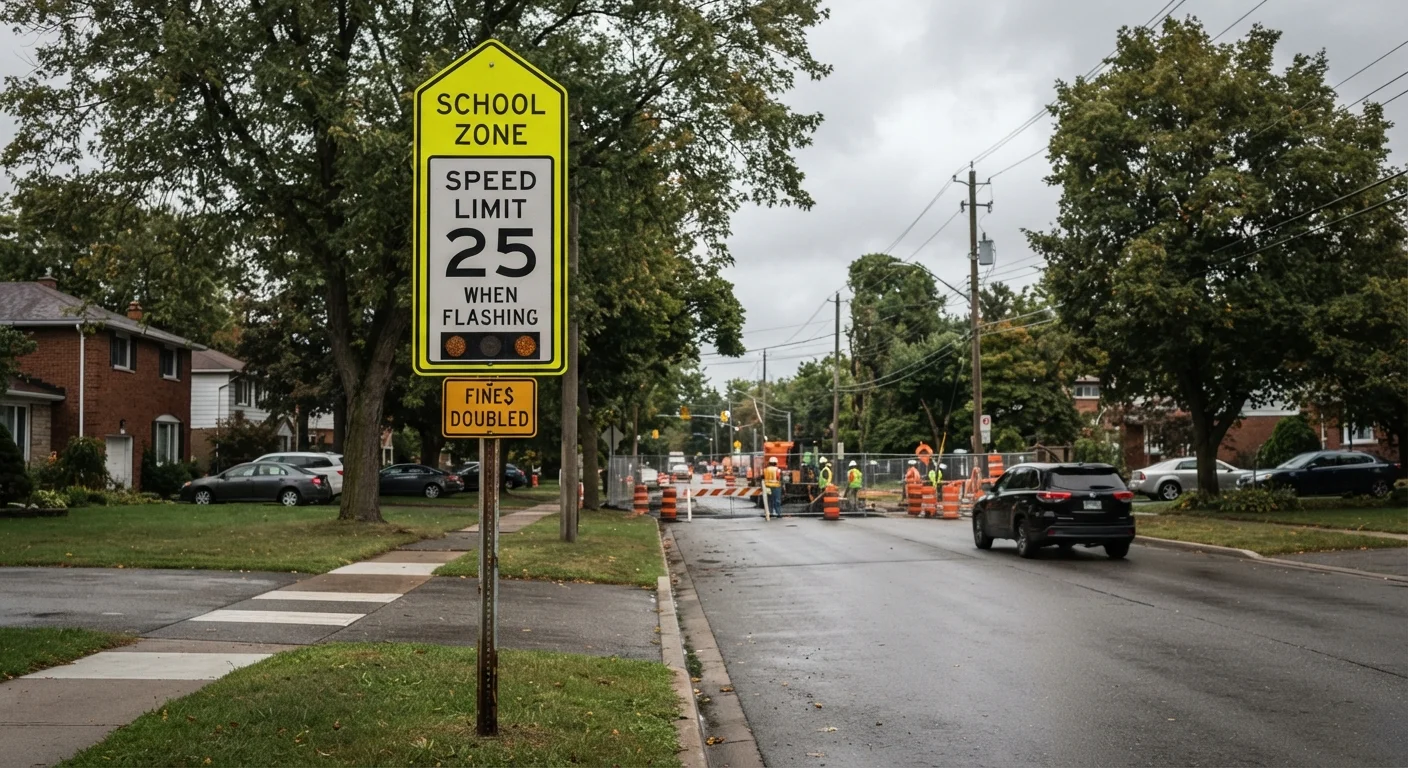
A school zone speed limit - typically 15 to 25 mph depending on the state - is only active during designated hours, usually when children are arriving or leaving school. In many jurisdictions, flashing amber lights on the school zone sign indicate the reduced limit is in effect. Driving at the posted road speed when those lights are flashing is a violation, even if you didn't see a child present.
Key rules that catch drivers off guard:
- Passing a stopped school bus: When a school bus extends its stop arm and activates red flashing lights on a two-lane road, all traffic in both directions must stop. On divided highways, rules vary by state - some require only approaching traffic to stop. Passing an active school bus stop arm is one of the most severely penalized traffic violations in the U.S., with fines ranging from $250 to over $1,000 on a first offense in many states.
- Speed enforcement: Many school zones use automated speed cameras where permitted by state law. Fines from camera-based systems often cannot be contested in the same way a police-issued ticket can.
- Zone boundaries: The school zone typically begins at signage, not at the school entrance. Watch for the start marker, not just the building.
Stop Arm
The extendable arm on the left side of a school bus that swings out when the bus stops to load or unload children. When the stop arm is deployed with red flashing lights, surrounding traffic is legally required to stop.
Move Over Law
A statute requiring drivers to change lanes away from, or slow down significantly near, emergency or service vehicles stopped on the roadside with lights activated. Every U.S. state has some form of this law.
Active Work Zone
A construction or maintenance zone where workers are physically present. Enhanced penalties for traffic violations - including doubled fines in most states - typically apply specifically when workers are present, not merely when equipment or signage is visible.
Zipper Merge
A lane-merging technique in which drivers in both lanes continue at speed to the lane closure point and then alternate turns merging, like a zipper. Traffic engineers widely endorse this method over early lane changes as it reduces total queue length and collisions.
Flagger
A trained worker stationed in a construction zone to manually direct traffic flow using paddles or flags. A flagger's directions carry the same legal weight as a traffic signal in most U.S. jurisdictions.
Construction Zones: Double Fines and Worker Proximity
Active construction zones - meaning workers are present, not just orange barrels - are subject to enhanced penalty statutes in every U.S. state. The most common enhancement is doubled fines for speeding. Several states also apply doubled points. A speeding conviction in a work zone can cost two to three times what the same violation would cost elsewhere, and some states treat it as a separate, more serious offense classification.
What drivers frequently miss:
- Posted zone speed vs. advisory signs: If a speed limit sign inside the zone shows a number, that is the enforceable limit - not a suggestion. Advisory speed signs (black on yellow) are not legally binding, but ignoring them significantly increases crash risk.
- Lane changes and merging: Construction zones often require early lane merging. Zipper merging - where both lanes use full available space before merging at the point of lane closure - is the technique recommended by traffic engineers and is now explicitly endorsed by most state DOTs. Our guide to freeway merging explains the mechanics in detail.
- Flaggers: A flagger has the same legal authority as a traffic signal. Disobeying a flagger's direction is treated as running a red light in most states.
Emergency Vehicles: Move Over Laws and Full Stop Requirements
Every U.S. state has a Move Over law. The core requirement: when an emergency vehicle - police, fire, ambulance, and in most states tow trucks and highway maintenance vehicles - is stopped on the roadside with lights activated, drivers must move to an adjacent lane if safely possible. If a lane change isn't safe or available, drivers must slow to a speed well below the posted limit, typically defined as a speed that is "reasonable and prudent" given conditions.
Failure to comply is a moving violation in every state and carries escalated penalties in most. Several states have expanded Move Over coverage to include utility vehicles and sanitation trucks.
When an emergency vehicle is actively approaching with lights and siren:
- Pull to the right edge of the road and stop - do not brake suddenly in the middle of a lane.
- Remain stopped until the vehicle has completely passed and is no longer a hazard.
- At intersections, clear the intersection first if already in it, then pull over - do not stop in an intersection.
Driving confidently in varied conditions, including understanding how to react when visibility is reduced or roads are unpredictable, is part of the same skill set. Our article on driving through hazardous weather conditions covers how environmental factors affect your stopping ability and reaction time - both of which matter in Move Over situations.
~857
Roadway workers killed annually in the U.S.
According to the Bureau of Labor Statistics, roadway worker fatalities consistently number in the hundreds each year, with a significant share involving struck-by vehicle incidents.
All 50
States with active Move Over laws
The National Highway Traffic Safety Administration confirms that as of recent years, every U.S. state has enacted some form of Move Over legislation.
2x-3x
Multiplier applied to work zone speeding fines
Most U.S. states double or triple standard speeding fines in active construction zones, according to the National Work Zone Safety Information Clearinghouse.
Penalties at a Glance and What to Do If You're Cited
Penalties for violations in these protected zones vary by state but follow recognizable patterns. First-offense school bus arm violations frequently result in fines of $250-$1,000-plus, points, and mandatory court appearances in some states. Work zone speeding typically doubles the standard fine and points. Move Over violations commonly carry fines of $100-$500 on a first offense, with significantly steeper consequences if a worker or responder is injured.
If you receive a citation in any of these categories:
- Do not ignore the citation - failure to respond typically results in a license suspension and additional fines.
- Review your state DMV's point schedule to understand the license impact before deciding whether to contest or accept the violation.
- Consider whether a defensive driving course is accepted by your state as a point-reduction option - many states allow this once per calendar year or once every few years.
Understanding how traffic violations can affect your broader financial picture - including insurance premiums - is worth considering alongside the immediate fine. General budgeting resources like strategies for building savings can help you plan for unexpected costs that citations sometimes trigger.
This article provides general educational information about U.S. traffic laws and penalties. Laws vary by state and are subject to change. Consult your state's DMV or a licensed attorney for guidance specific to your situation.