Why Shape and Color Come Before the Words
Every traffic sign in the United States is designed to communicate at a glance - before you've had time to read a single word. The Federal Highway Administration's MUTCD assigns specific shapes and colors to specific categories of information, so a driver trained on the system can process intent instantly, even at highway speeds.
Shape is especially powerful because it works when a sign is partially blocked or faded. Color adds a second layer of meaning. Together, they form a redundant system that helps you act correctly even under poor conditions.
| Federal standard governing U.S. signs | MUTCD (Manual on Uniform Traffic Control Devices) (Federal Highway Administration) |
| Number of standardized sign colors | 11 (including fluorescent yellow-green and coral) (MUTCD, current edition) |
| Shape of a stop sign | Octagon - unique to stop signs in the U.S. (MUTCD) |
| Shape of a yield sign | Downward-pointing equilateral triangle (MUTCD) |
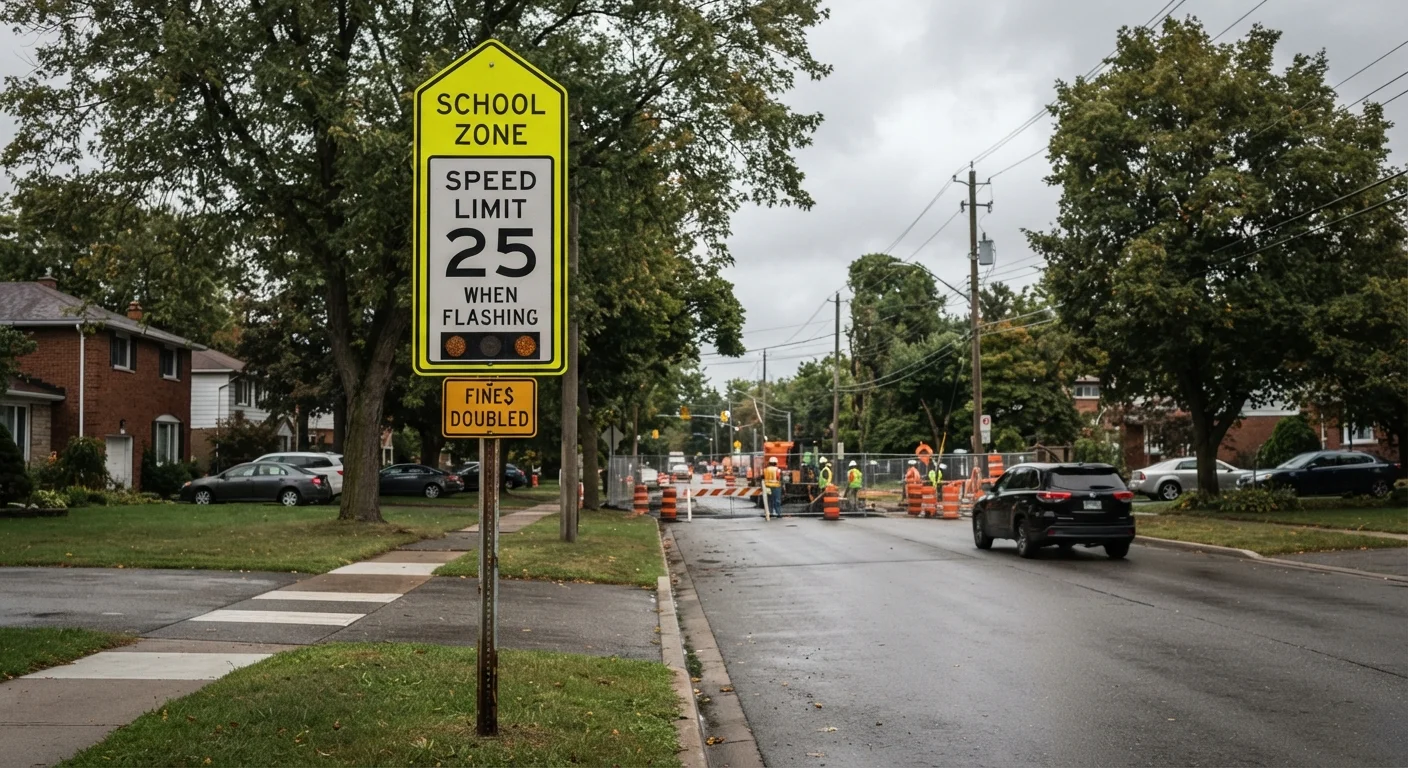
| Color of school zone warning signs | Fluorescent yellow-green (MUTCD) |
| Color of highway guide signs | Green with white lettering (MUTCD) |
Traffic Sign Shapes: What Each One Means
The MUTCD assigns shapes to sign categories - not individual signs - so the shape tells you the type of instruction before you read the content.
| Shape | Category | Common Examples |
|---|---|---|
| Octagon | Stop only | Stop sign |
| Equilateral triangle (point down) | Yield only | Yield sign |
| Diamond | Warning | Curve ahead, pedestrian crossing, deer crossing |
| Pentagon (point up) | School advance / school zone | School zone warning |
| Rectangle (vertical) | Regulatory | Speed limit, do not enter, turn restrictions |
| Rectangle (horizontal) | Guide / informational | Route markers, distance signs |
| Circle | Railroad advance warning / route markers | Railroad crossing advance sign |
| Pennant (horizontal point right) | No passing zone | No passing pennant |
| Crossbuck (X shape) | Railroad crossing | At-grade railroad crossing marker |
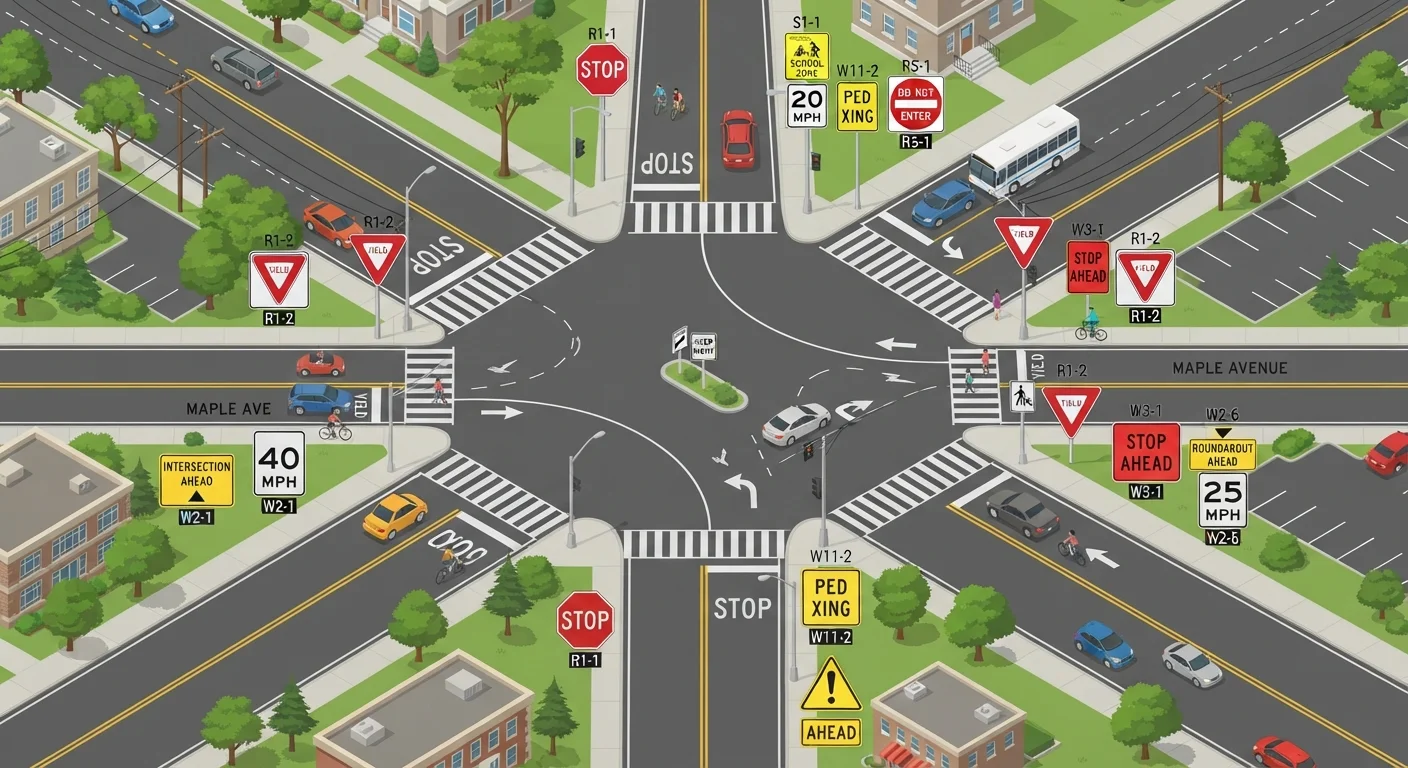
Understanding these shapes is the foundation of fast, confident reading on the road. For situations where shape and right-of-way interact - like yield signs at intersections - see our guide to right-of-way rules.
Shape Recognition Works Even When Text Doesn't
Traffic sign shapes are intentionally unique so that drivers can recognize a sign's meaning even if it's obscured by snow, glare, or damage. The octagon, for example, is used exclusively for stop signs in the U.S. - no other sign shares that shape. Memorizing shapes as a backup to reading text is a genuinely useful driving skill.
Traffic Sign Colors: The Full Lookup Reference
Color encodes the purpose of a sign. The MUTCD designates eleven official colors, each with a defined meaning:
- Red
- Stop, prohibition, or do-not-enter. Found on stop signs, yield sign borders, wrong-way signs, and no-turn markers.
- White
- Regulatory information. Speed limits, lane controls, and most rule-based signs use white backgrounds with black or red text.
- Yellow
- General warning. The classic diamond-shaped warning sign background - used for curves, intersections, merges, and road condition alerts.
- Fluorescent yellow-green
- Pedestrian, bicycle, and school zone warnings. This high-visibility shade was added specifically to improve detection in low-light and adverse weather.
- Orange
- Temporary traffic control and construction zones. All work-zone signs use orange. Fines in these areas are often doubled - see our article on high-penalty zones for details.
- Green
- Guide and directional information. Highway signs indicating exits, distances, and destinations.
- Blue
- Motorist services. Rest areas, hospitals, fuel, lodging, and food along interstates.
- Brown
- Recreational areas, parks, and cultural or historical sites.
- Black
- Used as text or symbols on white regulatory signs.
- Coral
- Incident management signs - typically temporary directional signs at crash or emergency scenes.
- Light blue
- Reserved for emerging uses under MUTCD guidelines; not yet widely deployed.
Putting It Together on the Road
In practice, shape and color work as a two-step filter. When you spot a sign, your brain registers shape first (is this a command, a warning, or information?) and color second (what domain - construction, school zone, highway?). The text confirms the detail.
For example: a diamond shape in fluorescent yellow-green means pedestrian or school warning before you read a word. An orange rectangle means construction zone - expect changed conditions. A red octagon means only one thing in the entire U.S. sign system: stop completely.
Roundabout signage is a practical area where color and shape recognition really matters - our roundabout explainer walks through the specific signs you'll encounter entering and exiting one.
Regulatory sign
A sign that communicates a legal requirement drivers must follow, such as speed limits, stop requirements, or turn restrictions. Violating a regulatory sign is typically a traffic offense.
Warning sign
A sign that alerts drivers to a potential hazard or change in road conditions ahead. Warning signs advise caution but do not mandate a specific action.
Guide sign
A sign providing directional, distance, or destination information to help drivers navigate. These are typically green or blue and carry no legal obligation.
MUTCD
The Manual on Uniform Traffic Control Devices - the federal standard published by the Federal Highway Administration that governs all traffic sign design, placement, and meaning in the United States.
Refreshing your knowledge of signs periodically - not just for a license renewal - is one of the simplest ways to drive more confidently and safely.