The Core Rule That Makes Everything Else Click
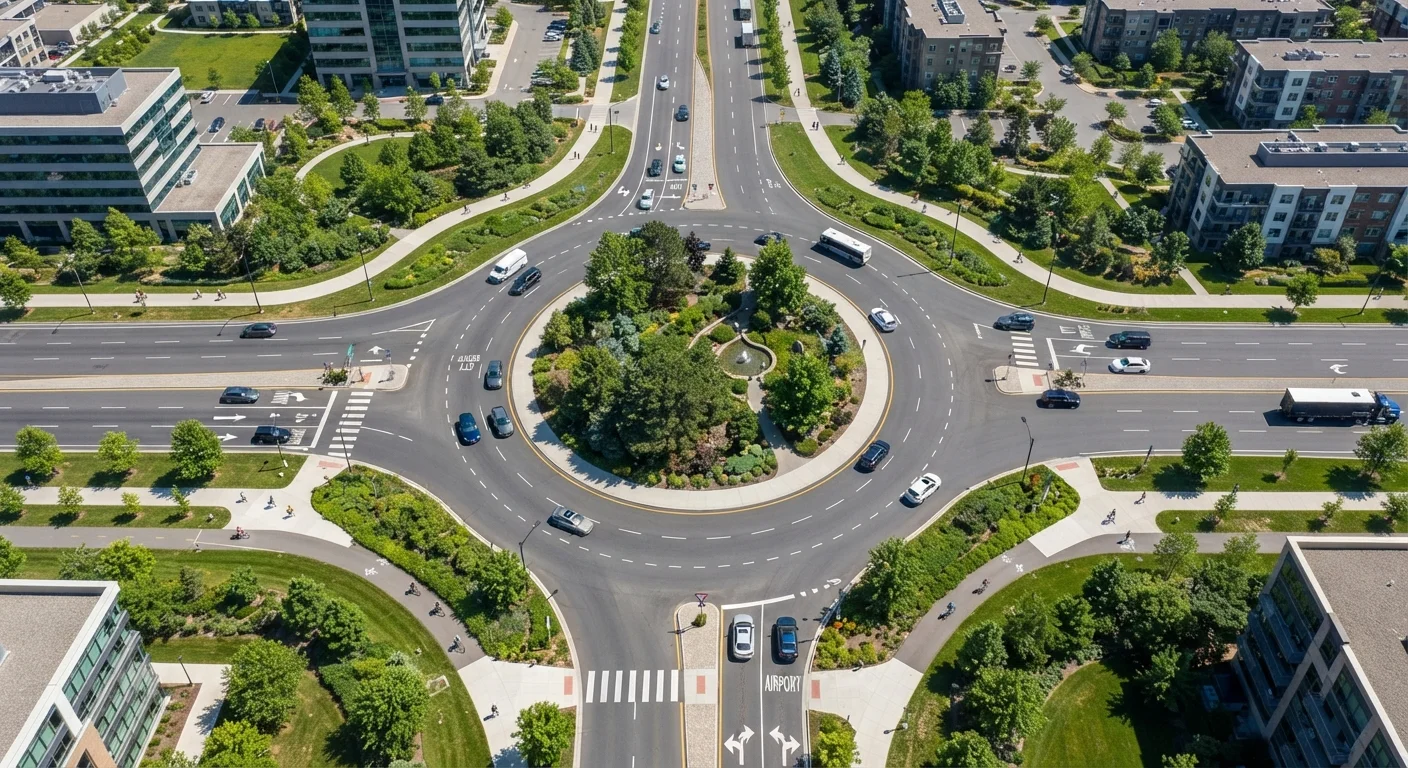
Most driver confusion at roundabouts comes down to one misunderstood principle: yield to circulating traffic, then enter. You are not stopping at a light or waiting for a signal - you're looking left, finding a gap in the flow, and merging smoothly when it's clear. Once you're inside the circle, you have priority over any vehicle trying to enter.
Think of it like merging onto a highway, just at much lower speeds. You match the flow, pick your moment, and go. If there's no gap, you wait at the yield line - not in the intersection itself. The same gap-judgment skills used for freeway merging apply here, scaled down to 15-25 mph.
Practice the Yield Line, Not the Stop
New roundabout users often instinctively stop at the entry even when the circle is clear. The yield line means 'stop only if necessary' - if there's no circulating traffic, you can enter without stopping at all. Unnecessary stopping disrupts flow and can confuse drivers behind you.
How to Navigate a Roundabout Step by Step
Breaking the approach into clear steps removes most of the uncertainty:
- Slow down on approach. Roundabout signage and road geometry are designed to bring your speed down naturally. Approach cautiously regardless of how clear the circle looks.
- Choose your lane early. In single-lane roundabouts this doesn't apply, but in multi-lane roundabouts, pick your lane based on your exit before you reach the yield line. Changing lanes inside is dangerous.
- Yield at the dashed line. Look left and wait for a safe gap in circulating traffic. Do not inch forward into the path of oncoming vehicles.
- Enter smoothly and maintain speed. Once you enter, keep pace with circulating traffic - typically 15-25 mph. Do not brake suddenly or slow below the natural flow without reason.
- Signal your exit. Activate your right turn signal as you pass the exit just before yours. This alerts pedestrians and other drivers of your intention.
- Exit and check for pedestrians. Crosswalks are on the exit ramps, not inside the circle. Yield to any pedestrian crossing before completing your exit.
If you miss your exit, don't panic. Continue around the circle and try again - that's what it's designed for.
Why Roundabouts Are Safer - and Why That Matters
Traditional four-way intersections create 32 potential vehicle conflict points. Roundabouts reduce that number to just 8. More importantly, the conflicts that do occur happen at low speeds and shallow angles - conditions that produce far less severe injuries than the right-angle, high-speed collisions common at signalized intersections.
~75%
Reduction in injury crashes vs. conventional intersections
According to the Federal Highway Administration, roundabouts produce roughly 75% fewer injury crashes than traditional stop-sign or signal-controlled intersections.
up to 90%
Reduction in fatal crashes
FHWA research indicates roundabouts can reduce fatal crashes by up to 90% compared to conventional intersections, primarily by eliminating high-speed right-angle conflicts.
8 vs. 32
Vehicle conflict points: roundabout vs. four-way intersection
Transportation engineers count 32 potential vehicle conflict points at a standard four-way intersection and just 8 at a comparable roundabout.
The safety advantage is especially pronounced for older drivers and pedestrians. Entry speeds are controlled by geometry, not willpower, so the design itself limits how fast a distracted or inattentive driver can enter the circle. This is why transportation engineers increasingly favor roundabouts for new intersection construction and retrofit projects across the U.S.
Understanding stopping distances is related: the same physics that makes tailgating dangerous explains why lower roundabout entry speeds matter so much for crash severity.
Common Mistakes and How to Avoid Them
Even experienced drivers make predictable errors in roundabouts. Here's what to watch for:
- Stopping inside the circle. Only stop inside if an emergency vehicle is approaching and you have no safe way to exit first. Otherwise, keep moving - stopping creates rear-end hazards.
- Ignoring pedestrian crosswalks. Crosswalks sit on approach and exit legs, not in the circle itself. Always yield to pedestrians crossing your exit path.
- Entering too fast. The yield sign means slow down and assess, not roll through. A driver entering at full speed has almost no time to react to circulating traffic.
- Wrong lane selection. In a two-lane roundabout, cutting across lanes to reach your exit is a leading cause of sideswipe crashes. Lock in your lane before entry.
For a broader foundation in right-of-way rules, the new driver fundamentals guide covers these concepts in full context. And if roundabout signage ever confuses you, the traffic sign shapes and colors reference explains exactly what each warning sign means.
Roundabouts vs. Traffic Circles: Not the Same
Older traffic circles and rotaries - common in the northeastern U.S. - operate differently from modern roundabouts. Some older designs give priority to entering vehicles rather than circulating ones, and may have higher posted speeds. Always check local signage and rules rather than assuming all circular intersections work identically.