How the Three Categories Actually Break Down
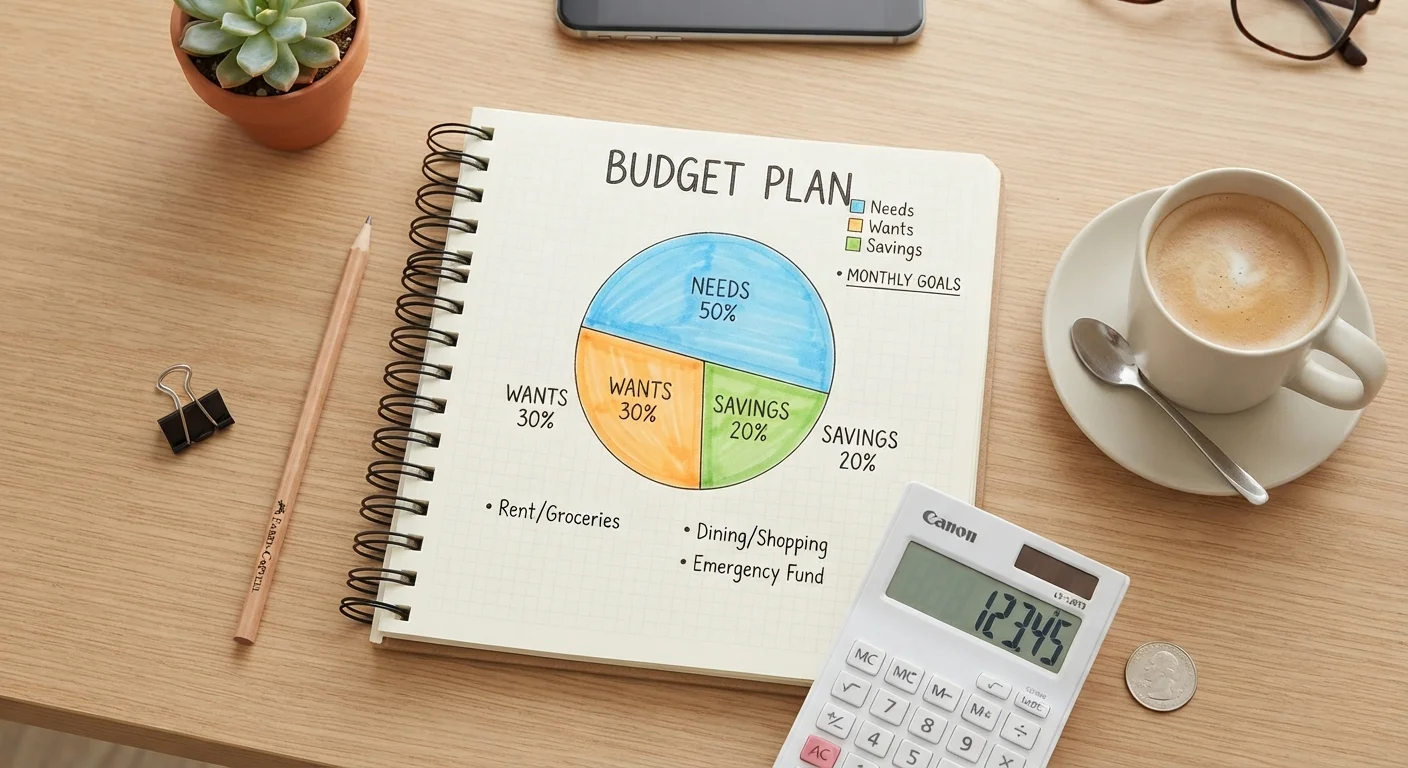
The framework starts with your after-tax monthly income. From there, you divide it as follows:
- 50% - Needs: Rent or mortgage payment, utilities, groceries, health insurance premiums, minimum loan payments, and reliable transportation to work.
- 30% - Wants: Dining out, streaming services, travel, hobbies, gym memberships, and non-essential shopping.
- 20% - Savings & Debt Repayment: Emergency fund contributions, retirement savings, extra debt payments beyond minimums, and other financial goals.
The line between needs and wants is the trickiest part. A basic phone plan is a need; upgrading to an unlimited premium plan is a want. Groceries are a need; weekly takeout is a want. Being honest about this distinction determines how useful the framework actually is for you.
The Rule Is a Starting Point, Not a Verdict
If your numbers don't hit 50/30/20 perfectly, that's normal - not a failure. The value of the framework is in what it reveals about your spending habits, not in achieving the exact split. Adjust the percentages to fit your income level, cost of living, and financial priorities.
This article is for general financial education purposes and does not constitute personalized financial advice. For guidance tailored to your specific situation, consider consulting a licensed financial professional.
When the 50/30/20 Rule Works Well
The rule is genuinely effective for a specific profile: someone with a stable monthly paycheck, moderate fixed expenses, and no urgent high-interest debt crisis. If you're a young homeowner with a predictable salary and you've never had a budget before, this framework can turn an overwhelming topic into a manageable starting point.
It works because it's forgiving. You don't need to categorize every latte or gas fill-up - just keep your three buckets roughly balanced. That low friction means you're more likely to stick with it. It also builds in the savings habit automatically rather than treating it as an afterthought.
For broader financial goal-setting - including building an emergency fund or saving toward a home project - the 20% savings slice maps directly onto the priorities covered in our Saving & Goals hub.
Where the Rule Runs Into Real-World Problems
The 50/30/20 rule was popularized as a general guideline, and its simplicity is both its strength and its limitation. Here's where it tends to break down:
30%+
Of income spent on housing by many US renters
The U.S. Department of Housing and Urban Development defines housing cost-burdened as spending more than 30% of gross income on housing; millions of American renters exceed this threshold.
57%
Of Americans living paycheck to paycheck
According to a 2023 LendingClub report, more than half of US consumers reported living paycheck to paycheck, underscoring why a savings-first budget structure is difficult but important.
$1,700
Average monthly student loan payment among borrowers
The Education Data Initiative estimates average monthly student loan payments in the US at roughly $500-$1,700 depending on balance, significantly affecting how much income is available for needs vs. wants.
- High housing costs: In many US metro areas, rent alone can consume 40-50% of take-home pay, leaving almost nothing for other needs before the 50% cap is reached.
- Irregular income: Freelancers, contractors, and commission-based workers can't reliably split a number that changes every month. The frameworks designed for variable income handle this better.
- High debt loads: If you're carrying significant student loans or credit card balances, aggressively funneling more than 20% toward debt payoff may make more financial sense than spending 30% on discretionary wants.
- Low income: When essentials exceed 50% of income - which is common for lower earners - the math simply doesn't work as designed, and the rule can feel discouraging rather than helpful.
In any of these situations, the percentages should be treated as adjustable targets, not fixed rules. The underlying principle - balance essentials, enjoyment, and future security - remains sound even when the specific numbers shift.
Putting It Into Practice
Getting started takes three steps:
- Calculate your monthly net income. Add up all take-home pay after taxes. If your employer deducts 401(k) contributions pre-tax, those may already function as part of your savings allocation.
- Total your current monthly spending by category. List every recurring expense and sort each into needs, wants, or savings/debt. Be honest about the category - this is where most people discover their actual spending pattern differs from what they assumed.
- Compare your actuals to the targets. If your needs are running at 60%, something has to give - either reduce a discretionary expense or acknowledge that the 30/20 split needs to flex accordingly.
Once you've established your allocation, you'll need a consistent way to track it. Whether you prefer a spreadsheet, a notebook, or a budgeting app, the method matters less than the consistency. Our comparison of pen-and-paper vs. spreadsheet vs. app budgeting can help you pick a tracking approach you'll actually maintain.
The 50/30/20 rule is one piece of a larger financial picture. For a more comprehensive view - from categorizing income to adjusting for life changes - see our complete personal budgeting resource.
This article is for general informational and educational purposes only and does not constitute personalized financial, tax, or investment advice. Consult a licensed financial professional for guidance specific to your circumstances.