
Why Organized Homes Don't Stay That Way
You spent a full weekend sorting, donating, and finding a place for everything. The house looked great. Then, six weeks later, the countertops were buried again. Sound familiar?
The initial declutter is a reset, not a solution. Clutter returns because most households don't have functional systems to handle the steady daily inflow of stuff - mail, purchases, kids' projects, impulse buys. Without a maintenance plan, entropy wins every time.
If you're still building your foundational approach, our guide for first-time homeowners covers the core organizational mindset from the ground up. This article picks up where the big sort ends.
Assign every object a permanent, specific home.
Clutter is largely the accumulation of things without designated places. When an object has one consistent location, it gets returned there automatically rather than set down wherever is convenient. This removes the daily decision fatigue of figuring out where things go.
Apply the one-in, one-out rule to every new purchase.
The volume of items in a home grows with every purchase, gift, or freebie. Matching each new arrival with a departure keeps the overall quantity stable over time, so you never need to do another full declutter.
Do a five-minute daily reset before going to bed.
A brief nightly sweep prevents small disorder from compounding into overwhelming mess. It also means you start each morning in a calmer, more functional environment - which tends to reinforce organized behavior throughout the day.
Process incoming mail and paperwork on the day it arrives.
Paper piles are one of the fastest forms of recurring clutter in most homes. A same-day habit - open, action, file, or recycle - prevents stacks from forming and important items from getting lost.
Avoid 'doom stacking' - don't set things down to deal with later.
Most clutter isn't caused by buying too much - it's caused by repeatedly deferring the decision about where something belongs. Each deferred item adds to a growing pile that becomes harder to address.
Core Practices for Lasting Organization
The habits below are the difference between a home that needs a full overhaul every few months and one that stays manageable with minimal daily effort. None of them require expensive storage solutions or a minimalist lifestyle - just consistent, low-effort action.
Making It Work With Everyone in the House
Organization systems only hold if everyone who lives in the space uses them. If your system requires more mental effort than just setting something down, it will be abandoned - by you and everyone else.
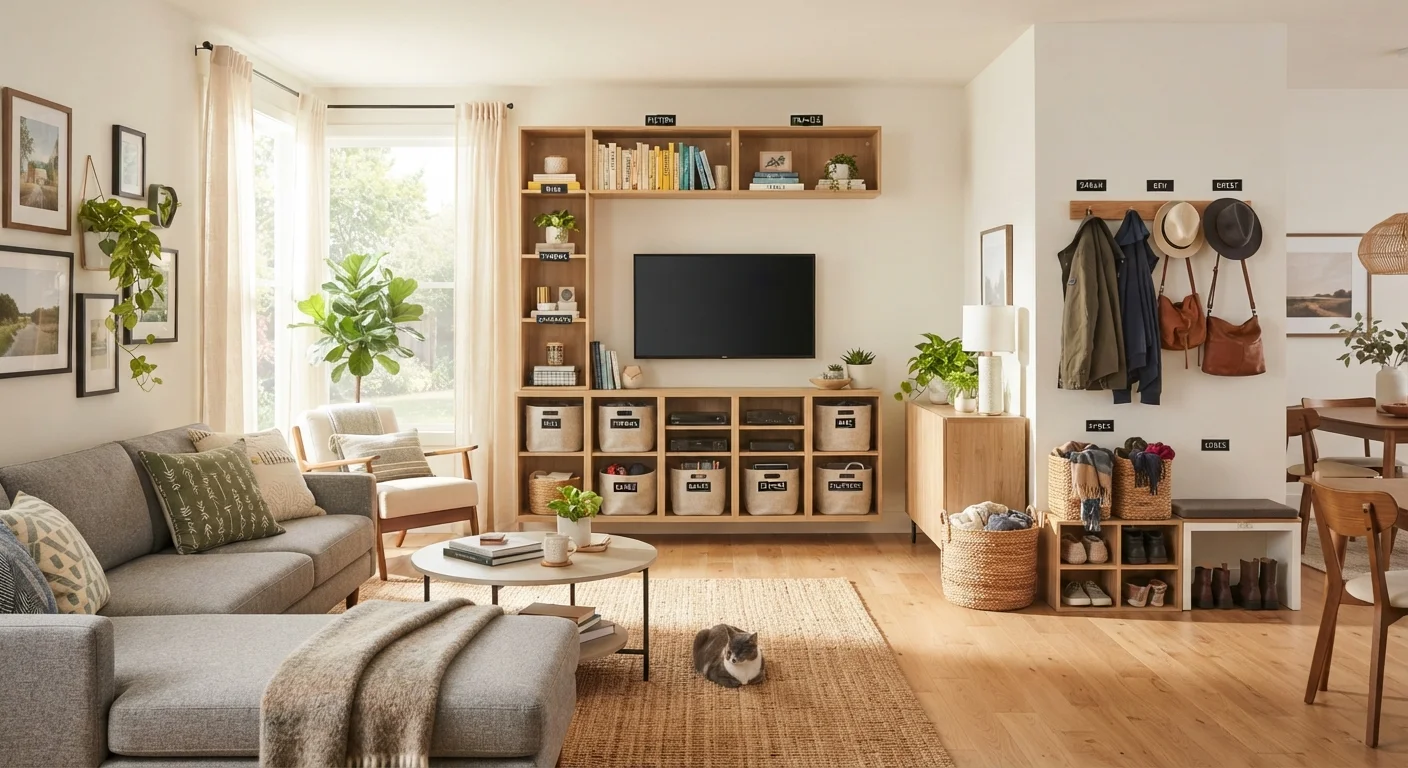
Keep storage solutions obvious and friction-free: open bins are easier to use than lidded ones, hooks beat hangers for coats, and labels remove the guesswork of where things belong. When the right choice is also the easy choice, people follow through.
For households with roommates, partners, or kids who have different habits, it's worth reading our article on organizing a home with multiple people. Shared agreements about high-traffic spaces - kitchens, bathrooms, entryways - matter more than personal preferences about individual rooms.
Organization Systems Should Fit Your Life
There's no single right way to keep a home organized - what works is whatever your household will actually use consistently. A complicated system that requires effort to maintain will collapse under everyday pressure. Start with the simplest possible version of a habit, and only add complexity if you find you genuinely need it.
Staying Ahead With Seasonal Check-Ins
Even the best daily habits won't catch everything. Stuff accumulates in closets, junk drawers, and garages in slow, nearly invisible increments. A quarterly audit - timed with the change of seasons - gives you a reliable opportunity to reassess before problems compound.
During each seasonal pass, ask three questions about every space: Does this still have a clear home? Is anything in here no longer used or needed? Has anything new moved in without being properly assigned a place?
Our seasonal declutter checklist walks through exactly what to examine each quarter, room by room. Pair it with our room-by-room organization walkthrough when a space needs a more thorough reset.
If you notice that storage containers and organizers keep multiplying without actually reducing clutter, you may be falling into a common trap - see organization myths that make homes harder to manage for a clear-eyed look at what actually works.