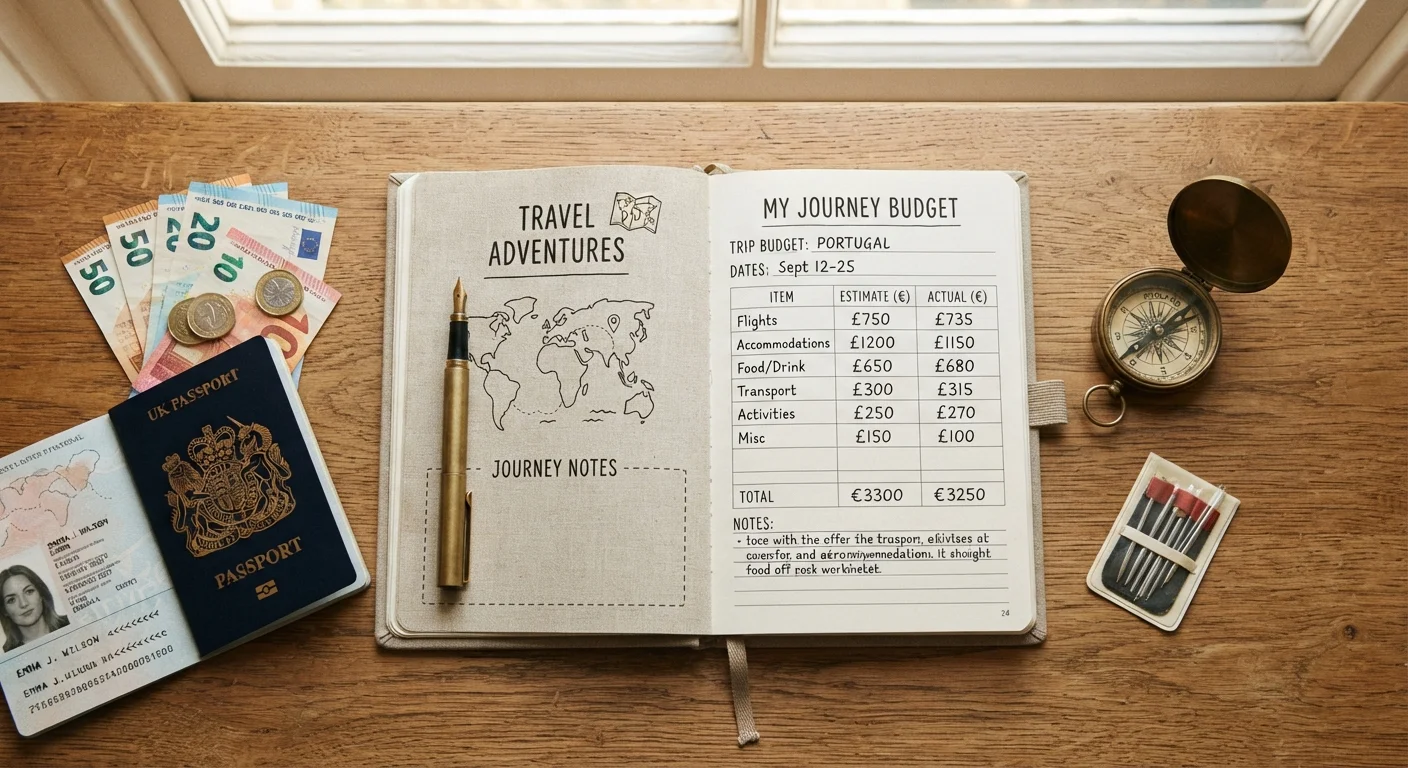

Why a Budget Framework Beats One-Off Estimates
Most travel budget mistakes happen before a single bag is packed. A traveler picks a number — often based on intuition or a quick search — books the trip, and hopes it holds. It rarely does, because a single estimate has no mechanism for catching what was missed, correcting course mid-trip, or learning from the outcome.
A framework is different. It treats budgeting as a repeatable four-phase process: estimate costs before booking, save systematically toward that target, track spending in real time, and review results after returning home. Each phase produces information that improves the next one.
If you're new to the fundamentals, Travel Budgeting From Zero lays out the core concepts before you commit to any numbers. This guide picks up where that foundation leaves off and walks the entire process end to end.
Build your food estimate using actual restaurant and grocery prices from the destination, not your home city. A $20/day food budget works in some Southeast Asian cities but falls short in Scandinavia.
Food costs are one of the most commonly underestimated categories because travelers default to familiar reference points rather than researching destination-specific pricing.
Set a hard rule to review your running totals before any discretionary purchase over a threshold you define — say, $50. That pause is often enough to catch drift before it becomes a problem.
Mid-trip overspending is rarely dramatic; it accumulates through small decisions. A simple personal rule creates a check-in moment that keeps spending aligned with the plan.
Phase 1: Estimating Your Total Trip Cost
A reliable estimate starts with categories, not totals. When you begin with a lump sum, you're guessing. When you begin with categories — transportation, lodging, food, activities, and a buffer — you're building a structured case for a number.
Spending Categories Every Travel Budget Should Include offers a full reference breakdown, but the working model is this:
- Transportation: Flights or driving costs, plus local transit (trains, buses, ride-shares).
- Lodging: Total nights multiplied by the realistic nightly rate for your destination and style.
- Food: A per-day estimate that reflects local prices, not your home city.
- Activities: Entrance fees, tours, experiences — research actual prices, not guesses.
- Buffer: A contingency of 10–15% of the subtotal covers delays, illness, or unexpected costs.
Research each category using actual data: airline fare ranges, hotel listing averages, and cost-of-living indexes for your destination. Estimates built on real data are far more reliable than rules of thumb. The Anatomy of a Well-Planned Trip explains how the estimation phase fits into overall trip planning.
10–15%
Recommended contingency buffer
Financial planners generally advise a 10–15% contingency on top of itemized travel costs to absorb unexpected expenses.
3–5x
Variance in daily food costs by destination
Cost-of-living indexes show daily food costs can vary by a factor of three to five or more between budget and high-cost destinations globally.
Phase 2: Saving Toward Your Target
Once you have a total estimate, the goal becomes concrete: a specific dollar amount by a specific date. The math is straightforward — divide the target by the number of months until departure to find a required monthly savings rate.
Building a Travel Budget Around a Real Salary works through exactly this reverse-engineering process using take-home pay and monthly expenses. If the required monthly rate isn't feasible given your current budget, you have two honest options: extend your timeline or reduce the trip scope.
Keeping travel savings in a dedicated account — separate from your emergency fund and everyday spending — reduces the temptation to redirect those funds. It also makes progress visible, which matters for motivation. For anyone whose income varies month to month, Budgeting on an Irregular Income offers adapted frameworks for irregular earners.
Phase 3: Tracking Spending While Traveling
The most common budgeting failure happens here: people create a solid plan, then stop paying attention once the trip begins. By the time they notice they're over budget, there's little room to adjust.
Real-time tracking doesn't have to be complicated. Tracking Spending While Traveling compares methods including spreadsheets, dedicated apps, and cash envelope systems. The right choice depends on your habits, not what sounds most sophisticated.
A few practical principles apply regardless of method:
- Log expenses daily, not at the end of the trip — memory degrades fast.
- Compare actuals against your category budgets every two to three days.
- If one category is running over, make a conscious choice to adjust another — don't just hope it averages out.
For readers interested in how the envelope method translates to travel, Envelope Budgeting in the Digital Age explains both physical and virtual versions of this approach.
Phase 4: Post-Trip Reconciliation
Reconciliation is the phase most travelers skip entirely — which means they carry the same blind spots into every future trip. Done properly, it takes less than an hour and produces lasting value.
Compare your actual spending in each category against what you estimated. Note where you were accurate, where you underspent, and where you went over. Then ask why. Did food cost more because you underestimated local prices, or because you made different choices than planned? Did transportation come in under budget because of a lucky fare, or because your estimate was genuinely solid?
This distinction matters. Luck-based accuracy tells you nothing; judgment-based accuracy confirms that your estimation method works. Document your findings in whatever system you used — a note in your spreadsheet, a page in a journal — so that data is available when you plan the next trip.
For a broader personal finance lens on this kind of review, Personal Budgeting: A Complete Resource covers how to integrate travel goals into a longer-term financial picture.
Building the Habit Over Multiple Trips
The framework described here compounds in value over time. Each completed trip improves your estimates for the next one, because you're drawing on real personal data rather than generic benchmarks. Within two or three trips, your category-level estimates will reflect your actual spending patterns — which is far more reliable than any calculator can provide.
The structural elements of the framework don't change: estimate, save, track, reconcile. What changes is the quality of the inputs. Your food-per-day estimate becomes grounded. Your buffer can be sized more precisely. Your savings timeline becomes predictable.
Trip Planning Basics and Budgeting Basics both offer additional frameworks that support this kind of iterative improvement across the financial and logistical dimensions of travel. For choosing how to track all of this, Pen-and-Paper vs. Spreadsheet vs. App weighs the trade-offs of each method so you can select one you'll actually stick with.
Traveling more without overspending isn't a matter of finding the right deals — it's a matter of running a repeatable system. That's what this framework gives you.